

Moissanite vs Diamond: Visual Clues, Photo Limits, and When to Test
Moissanite vs diamond: spot visual clues in photos, learn what a single image can't prove, and follow a clear verification path before paying for lab testing.
Quick answer for moissanite vs diamond
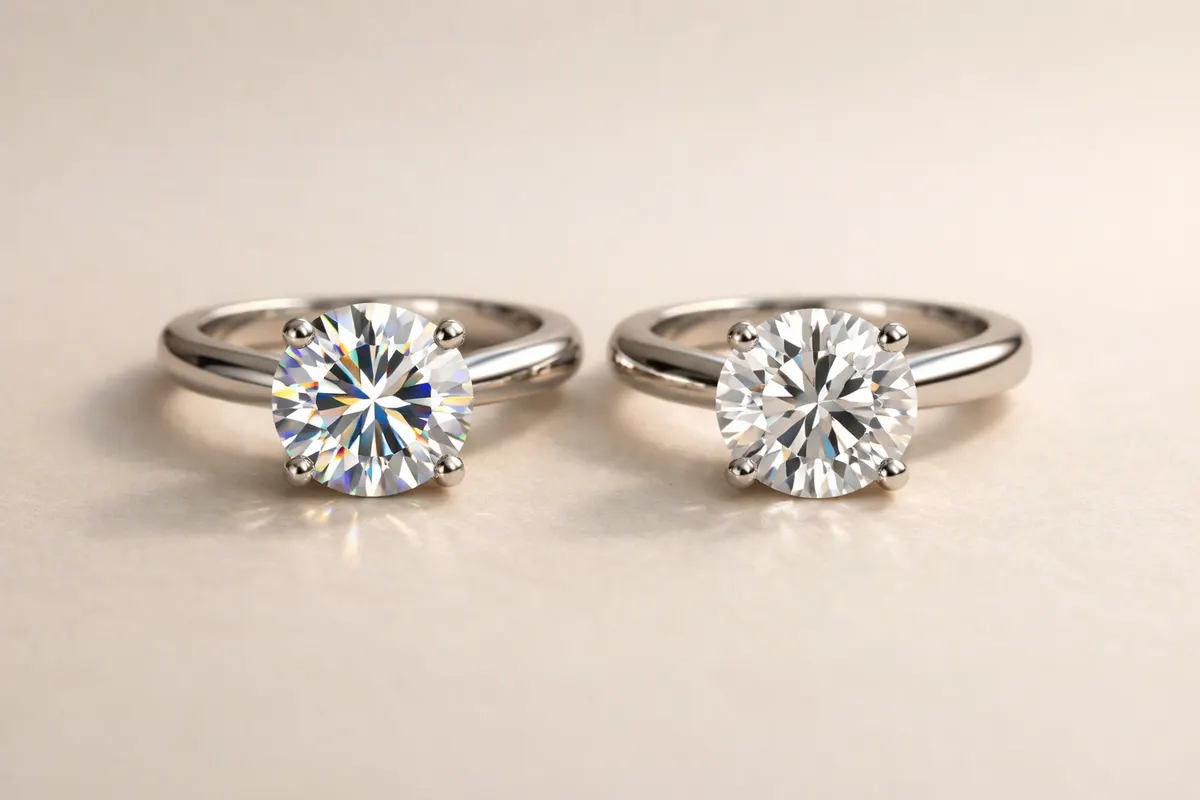
Moissanite vs diamond is mainly a question of visual behavior plus material tests: moissanite often shows stronger “disco” fire and slight doubling of facet edges under magnification, while diamonds typically have crisper facet lines, subtler fire, and different optical properties. Photographs can show these tendencies, but a single phone image cannot prove identity or value.
If you need a practical takeaway: use photos to collect visible clues—sparkle character, facet edge sharpness, setting and hallmarks, and any inscriptions—then decide whether to pursue in-person tests or a lab report. Treat images as hypothesis-building, not proof.
When money or authenticity matters—resale, estate pieces, insurance, or purchase—plan to escalate from photographic clues to reliable tests. Some standard jewelry tools (loupe, polarized filter, electrical and optical testers) and professional grading labs provide definitive answers that photos cannot.
- Photo clues can point at moissanite vs diamond but cannot confirm authenticity.
- Look for stronger, rainbow-colored fire and doubled facets to suspect moissanite in photos.
- Always follow photo clues with targeted in-person tests or lab reports when the outcome affects money or trust.
Comparison table
This quick reference compares visible traits, how confident you can be from photos, and recommended next steps for each stone. Use it as a checklist when you examine images or ask a seller for better photos.
Photos give different signals depending on lighting, magnification, and camera quality; the table focuses on consistent patterns that often appear in images, then suggests the right follow-up actions.
Remember: confidence from a photo is moderate at best. The table’s “photo confidence” column shows how reliable a visual clue is when you only have images.
- Trait — Moissanite — Diamond — Photo confidence — Next step:
- Sparkle character — Very strong, often multicolored fire and a lively disco-like flash — Brighter white brilliance with controlled fire — Medium confidence; photos that exaggerate lighting can mislead — Ask for daylight and incandescent photos, or take controlled shots.
- Facet edges/multiplicity — Slight doubling of facet edges or faint ghosting in some views because of birefringence — Single sharp facet junctions; no doubling — Medium-high confidence under magnification photos (10x) — Request macro images with a loupe or have a jeweler inspect with a loupe.
- Hardness/wear — Shows minimal wear but slightly different edge wear patterns at extreme close-up — Extremely hard; edges blunt very slowly — Low confidence from photos alone — Inspect under magnification in person for edge rounding patterns.
- Setting & marks — Often set in sterling, lower-carat gold, or unusual mounts for cost reasons; rare laser inscriptions — Often set in higher-quality settings and may have laser inscriptions or certificates — Medium confidence — Check maker marks, metal stamps, and ask for documentation.
- Thermal tester result — May read as diamond on simple thermal probes — Reads as diamond on thermal probes — Very low confidence because basic testers can’t tell them apart — Use electrical conductivity or lab refractive index tests.
When to use each
Use photographic inspection and the moissanite vs diamond clues when you need a fast, low-cost first pass: verifying seller photos, screening marketplace listings, or preparing documentation before a jeweler visit. Good photos will let you sort obvious lookalikes and gather targeted questions for the seller.
Reserve in-person testing or lab reports when the outcome matters financially or legally—like resale pricing, estate appraisal, insurance, or legal disputes. If photos show high-risk signs (very strong rainbow fire, doubling, mismatched metal stamp), schedule an in-person test before you pay a significant amount.
If your goal is curiosity—identifying a family ring or confirming a sentimental piece—start with careful photos and a loupe inspection. If the piece might be valuable or you plan to insure or sell it, expect to invest in an expert opinion and possibly a grading certificate.
- Fast screening: use photos and checklist to flag likely moissanite or diamond.
- Everyday curiosity: photos + loupe inspection may be sufficient.
- High-stakes decisions: in-person gemological testing or a lab report is required.
Common confusions
Sparkle alone causes most mix-ups. Moissanite tends to show intense, colorful fire in many lighting conditions, which some shoppers read as “more beautiful” or “more valuable. ” Diamonds usually prioritize white brilliance over rainbow fire; photos with strong direct lighting amplify whichever property the stone shows and can therefore mislead.
Thermal diamond testers often confuse moissanite and diamond because both conduct heat well. A positive thermal test is not definitive for diamond when moissanite is a possibility. Similarly, inexpensive macro photos can exaggerate color casts from camera sensors, making a near-colorless moissanite look warm or a faintly tinted diamond look odd.
Setting and metal marks are helpful but not conclusive. Sellers sometimes place lower-cost stones in higher-end settings or re-use fine mountings. Conversely, high-quality moissanite may be set in good metal. Use setting clues to guide suspicion—not to decide authenticity without further checks.
- Mistaking fire intensity for value—moissanite’s fire ≠ diamond value.
- Relying on single lighting photos—lighting changes apparent color and sparkle.
- Misreading thermal tester results—standard thermal probes can be fooled by moissanite.
Verification path
Follow a staged verification path: gather high-quality photos, check visible setting clues, perform in-person quick tests if possible, and then choose a lab or gemologist for definitive identification. This tiered approach saves time and expense by escalating only when needed.
Photograph checklist: take a macro close-up in daylight, a crown-on (face-up) shot under mixed light, a side profile to show depth and pavilion angle, and a photo that captures any maker’s marks, hallmarks, or inscriptions. Include a ruler or coin for scale and note the lighting used. These images help a jeweler triage the piece remotely without assuming identity.
In-person quick checks a trained jeweler can do: loupe inspection at 10x for facet doubling or internal inclusions, polarized light (to reveal birefringence/doubling), and an electrical conductivity tester that discriminates moissanite. If uncertainty remains or value is high, request a refractive index measurement or a gem lab report from a reputable lab.
Lab-level confirmation and when to use it: send the stone or piece to an independent lab (GIA, AGS, or a respected local lab) if you need definitive identity and grading for sale, insurance, or legal reasons. Labs use refractive index, spectroscopy, and professional microscopy to distinguish moissanite from diamond and to provide grading that photos cannot match.
When working with professionals, bring your photographic record and any provenance or receipts. If you start with a mobile app or an organized photo checklist, you’ll save time and ensure the expert tests the right properties. For more on visual appraisal steps and when to escalate to a lab, a focused appraisal guide gives additional context.
- Photo set to collect before in-person testing: daylight macro, mixed light face-up, side profile, and hallmark close-up.
- Quick in-person checks: 10x loupe, polarized light, electrical conductivity test.
- Definitive tests: refractive index, spectroscopy, lab report from reputable lab.
Related guides
Organize photo clues before you test
Use Jewelry Identifier to collect and organize the visible stone and setting clues from your photos, then decide the right next step—loupe inspection, jeweler tests, or lab confirmation. The app helps you prepare targeted questions and evidence for a professional when a definitive test is needed.
Take the next step →Frequently asked questions
Can you tell if a stone is moissanite or diamond from a single photo?
No — a single photo can suggest one or the other, but it cannot prove identity. Lighting, camera settings, and angle change how fire, brilliance, and color appear. Use multiple controlled photos plus in-person tests for reliable identification.
Why does moissanite look spaklier than diamond in pictures?
Moissanite has higher dispersion than diamond, which creates more colorful fire. Photos that favor strong point sources of light will exaggerate that effect. The result is vivid rainbow flashes that can make moissanite look ‘sparklier’ in images.
Will a jeweler’s diamond tester work on moissanite?
Many common thermal diamond testers cannot reliably distinguish moissanite from diamond because both materials conduct heat well. Jewelers use electrical conductivity testers, polarization, refractive index measurements, or lab instruments to separate the two accurately.
When should I pay for a lab report?
Purchase a lab report when the outcome affects price, insurance, or legal ownership—such as selling a high-value piece, insuring an heirloom, or settling an estate. For lower-value items or quick curiosity, a jeweler’s in-person inspection is usually a cost-effective first step.