

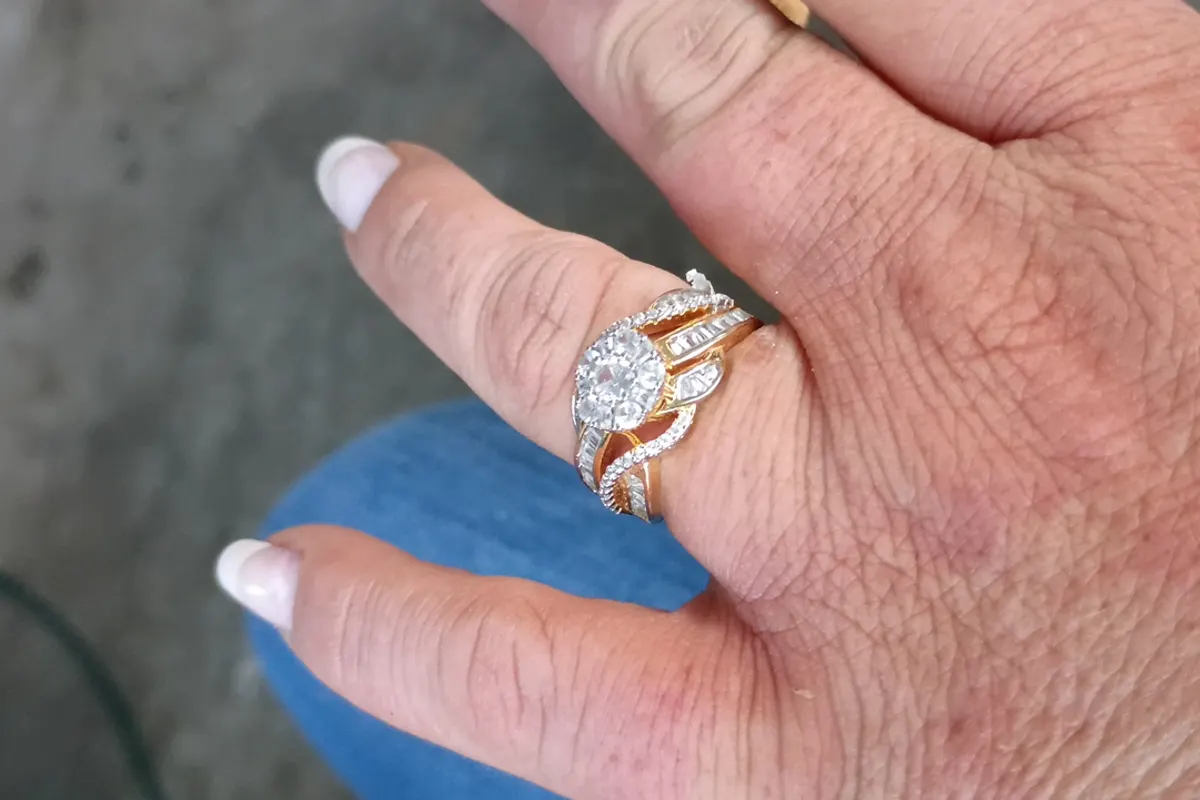
Two-tone gold ring with center diamond (approx. 1.0–1.5 ct)
Estimated value
$3,000 – $8,000
See a focused example of how to spot fake diamonds tests you can do at home, with photo clues, common lookalikes, and why lab checks may be needed.
Identification summary
This entry documents a contemporary two-tone gold ring bearing a solitare-center stone visually identified as a diamond from a single photo. The scan metadata notes a center stone of approximately 1.0–1.5 ct and a total diamond weight estimated at 1.8–2.5 ct.
Visible clues—bright white sparkle, faceting consistent with brilliant cuts, and a prong setting—support the diamond identification but cannot confirm material, treatments, or lab-grade authenticity from the image alone.
The photo-based identification carries medium confidence; the estimated retail value range is $3,000–$8,000, and professional gemological testing is recommended for final authentication or valuation.
Era
| Era | Contemporary (2000s–Present) |
|---|
Origin
| Origin | Contemporary |
|---|
Material
| Material | Gold (Two-Tone: Yellow and White) |
|---|
Condition
| Condition | good |
|---|
Physical Details
| Physical Details | Center stone approx. 1.0 - 1.5 ct; total diamond weight approx. 1.8 - 2.5 ct (estimate) |
|---|
Authentication
| Authentication | Photo-based identification — Medium confidence; visible cut and sparkle suggest diamond but lab testing required for certainty |
|---|
Estimated Value
| Estimated value | $3,000 - $8,000 |
|---|
Scan source
| Scan source | scans |
|---|
Historical context
Two-tone gold rings with a single brilliant-cut center stone became common in the early 2000s and remain popular for engagement settings; the contemporary date is consistent with the design and finish visible in the photo.
Market demand and resale pricing for such pieces depend heavily on verified carat weight, cut quality, and whether the center stone is natural, treated, or a simulant—factors that cannot be resolved definitively from a single image.
Keep identifying
Read the full category guide for the visual clues behind this identification.
Diamond Identification — What to Look For, With Real ExamplesRelated guides
Have your own diamond identification identified
After you’ve walked through these visual checks, use the Jewelry Identifier app on your device to organize photos, tag visible clues, and keep notes on setting, inscriptions, and estimated weights. Treat the app as a structured first pass that helps you prepare for professional verification; it’s a practical way to gather the images and observations a jeweler or lab will need.
Take the next step →Frequently asked questions
What quick photo checks can help spot a fake diamond at home?
Look for bright white sparkle across many facets, crisp facet edges, and how the stone disperses light in the image. Check the setting: genuine diamonds are usually set in quality prongs or bezels; loose glue or thin, poorly matched settings can indicate a simulant. Also compare the stone to known references in size and proportion. Remember, these checks suggest plausibility but don’t replace lab tests.
Can a single photo prove whether a stone is real or fake?
No. A single photo can show helpful visual clues—sparkle, facet geometry, and setting quality—but it cannot measure hardness, refractive index, specific gravity, or detect treatments and synthetics. The scan for this ring reports Medium confidence because photos provide valuable hints but not definitive proof.
Which at-home tests are safe and which should be avoided?
Safe checks include careful visual comparison, the fog test (briefly breathe on the stone to watch how quickly condensation clears), and examining the setting and hallmarks. Avoid destructive tests such as scratching the stone, using high heat, or chemicals. For anything beyond visual triage, consult a jeweler or send the piece for gemological testing.
When should I get a lab certificate for a stone that looks like a diamond?
Seek lab certification when the stone’s value, sale, or transfer matters—typically for center stones over one carat, heirloom pieces, or items intended for resale. Accredited labs (GIA, AGS, IGI, etc.) provide reports that establish origin, treatments, and characteristics; costs vary, but the certainty they provide is essential for high-value decisions.