Jewelry Identification
Quick Visual Guide to Jewelry Styles: Identify by Photo
Learn how to spot common jewelry styles by visible clues and what a photo identification report includes. Practical tips for photographing and next checks.
To compare jewelry styles, start with silhouette, decoration, scale, and how the piece is put together. A clear photo can suggest a useful style label, such as Art Deco-inspired, minimalist, or statement jewelry, and help you decide which details deserve a closer look.
Keep style, age, and materials separate. A newly made brooch can borrow a historic design, a simple ring can be old, and an oversized necklace can use precious or inexpensive materials. A visual resemblance does not establish when an object was made, who made it, or what it is worth.
Use this guide to describe your piece before trying the photo identifier. Photograph the front, back, fastening, and any readable marks, then compare the suggestions with those observations. Treat a possible era or maker as a research lead until stronger evidence supports it.


How identification works
Step 1
Snap a photo
Take a clear, well-lit photo of your item in the Jewelry Identifier By Picture app.
Step 2
Get an instant identification
The app reads the visible clues and returns the closest matches in seconds.
Step 3
Review the details
Compare the result with your photo, review any uncertainty, and check the suggested next steps.
A visual checklist for common jewelry styles
Begin with what you can describe without guessing: curved or angular outlines, repeated shapes, large or delicate proportions, and visible surface decoration. A style label becomes more useful when several details agree. One flower, pearl, or geometric stone setting is rarely enough.
Art Nouveau is associated with flowing lines and nature-inspired forms; the Metropolitan Museum of Art’s Art Nouveau overview provides useful design context. For Art Deco, compare repeated geometry and strong visual structure with documented examples. These are starting points for comparison, not an authentication checklist.
Use a plain background and even, indirect light. Take one straight-on overview, then separate close-ups of the back, setting, clasp, and any stamp. Include a ruler for scale and keep the original photos; heavy filters, glare, and aggressive sharpening can obscure the details you want to compare.
- Art Deco-inspired: look for repeated geometric shapes, stepped outlines, and a deliberate sense of symmetry. These features also appear in later revivals and current designs.
- Art Nouveau-inspired: look for sinuous curves and stylized plants, insects, or other natural forms. Photograph the entire composition as well as the decorative details.
- Minimalist jewelry: look for restrained decoration, simple shapes, and attention to proportion. Minimalism describes an aesthetic, not a reliable manufacturing date or metal quality.
- Statement jewelry: look for a focal piece whose size, color, texture, or arrangement draws attention. The label does not tell you how finely it was made or how valuable it is.
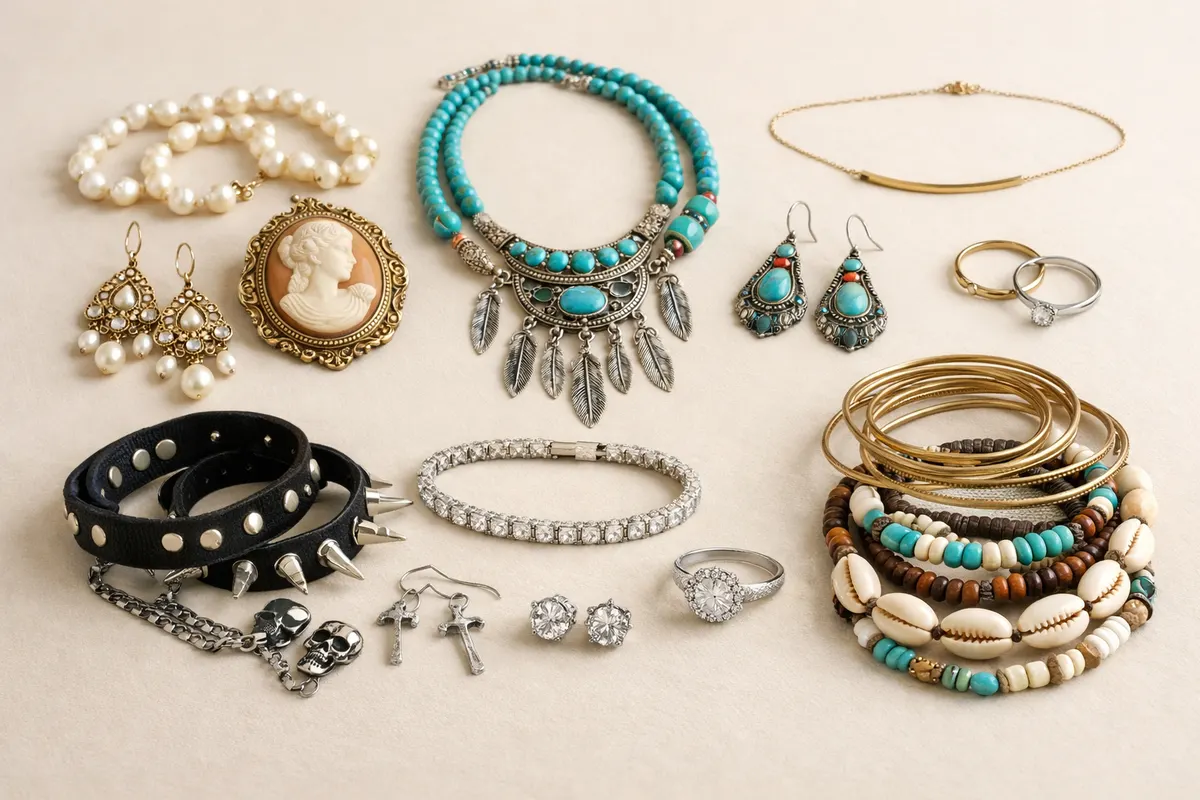
- Historic or revival influences: note cameos, floral motifs, engraving, and elaborate settings, then look for a combination of construction and documentary evidence before naming a period.
- Materials and marks: record metal color, surface wear, and the exact characters you can read. Avoid turning a color, stamp, or apparent gemstone into a claim of verified composition.
What the photo tool can help you compare
The free Jewelry Identifier tool offers a first-pass read of a jewelry photo. Its scope includes the likely item category, visible material and gemstone clues, style or age signals, condition observations, and possible next checks. Results depend on what the photo shows; they are not a laboratory report or a documented attribution.
Use the output to improve your questions. If it suggests Art Deco influences, compare the outline, repeated shapes, and setting arrangement with your own photos and the Art Deco jewelry guide. If a feature is not visible, leave it unresolved rather than treating a confident phrase as evidence.
For example, a large rectangular ring with repeated angular details might be described as geometric or Art Deco-inspired while its date remains unknown. A thin plain band might fit a minimalist aesthetic while its metal and maker remain unverified. These are illustrative comparisons, not authenticated cases or results from actual scans.
- Record the item type first: ring, brooch, necklace, bracelet, pendant, or earring.
- Separate the suggested style from the visible features that support it, and note any conflicting clues.
- Request a clearer photo when a stamp, setting, fastening, or worn surface is difficult to interpret.
- Use professional inspection for important questions about age, maker, gemstone identity, metal composition, or value.
Lookalikes that need more than a style match
Historic originals, later revivals, and modern handmade pieces can share the same visual vocabulary. Symmetry, patina, solder, and uneven finishing each need context. None provides a dependable date by itself, and a repaired or replaced component may differ from the rest of an older object.
The Victoria and Albert Museum’s history of jewellery shows how makers repeatedly revisited earlier designs and how factory production and handcraft coexisted. Compare documented objects and construction evidence together instead of assuming that all older jewelry was irregular or handmade.
Keep potentially fragile pieces intact while researching them. Avoid scraping, harsh cleaning, or improvised chemical tests just to expose a mark. The Jewelry Care guide explains useful handling precautions; an appraiser or jeweler can help when the attribution or value matters.
- Victorian-looking versus Victorian-made: ornate details and floral motifs can suggest an influence, but a later revival can reproduce them. A rough finish does not prove age, and a neat finish does not prove recent manufacture.
- Pearl jewelry: shape, matching, knots, and clasps alone cannot establish the age of a necklace or distinguish natural from cultured pearls. Restringing and repairs can change its appearance.
- Art Deco-inspired versus period Art Deco: geometry supports a style comparison. Confirming period manufacture needs additional evidence, such as consistent construction, reliable marks, documented history, or expert assessment.
- Gold-colored versus verified gold: exposed contrasting metal may raise a question about plating, but surface color and stamps alone do not establish composition. Keep material testing separate from style identification.
Frequently asked questions
How can I recognize Art Nouveau influences in a brooch?
Look for flowing, sinuous lines and stylized natural forms in the overall composition. A flower motif alone is not enough, and later jewelry can imitate the same style. Photograph the front and back, including any marks, and treat the style match as a lead for further research.
Which photos help most when comparing jewelry styles?
Start with a straight-on view of the complete piece, then capture the reverse, clasp, settings, and readable marks. Use soft light and a ruler for scale. A second angle can help with a shallow stamp, but do not force a clasp or polish a fragile surface to make the photo clearer.
Can a photo identification confirm authenticity or value?
No. A photo can suggest categories and highlight details to investigate, but it cannot establish authenticity, composition, or a reliable appraisal value. Use the result to organize your questions and seek professional inspection when those conclusions matter.
Does machine-made symmetry mean a piece is modern?
No. Machine production has a long history, and modern makers also work by hand. Symmetry, seams, engraving, and repairs must be interpreted together with marks and reliable reference material. A single manufacturing clue is not enough to date a piece.
Related guides
Compare your piece with Jewelry Identifier
After photographing the visible details, try the free jewelry identifier for a first-pass photo read. Use its style suggestions to guide comparison and decide what needs a clearer image or hands-on verification.