

What Does 925 Mean on Jewelry? Silver Stamps, Plating, and Next Checks
Learn what does 925 mean on jewelry, which visual clues a 925 stamp can and cannot prove, how to spot plating or wear, and safe next checks before testing.
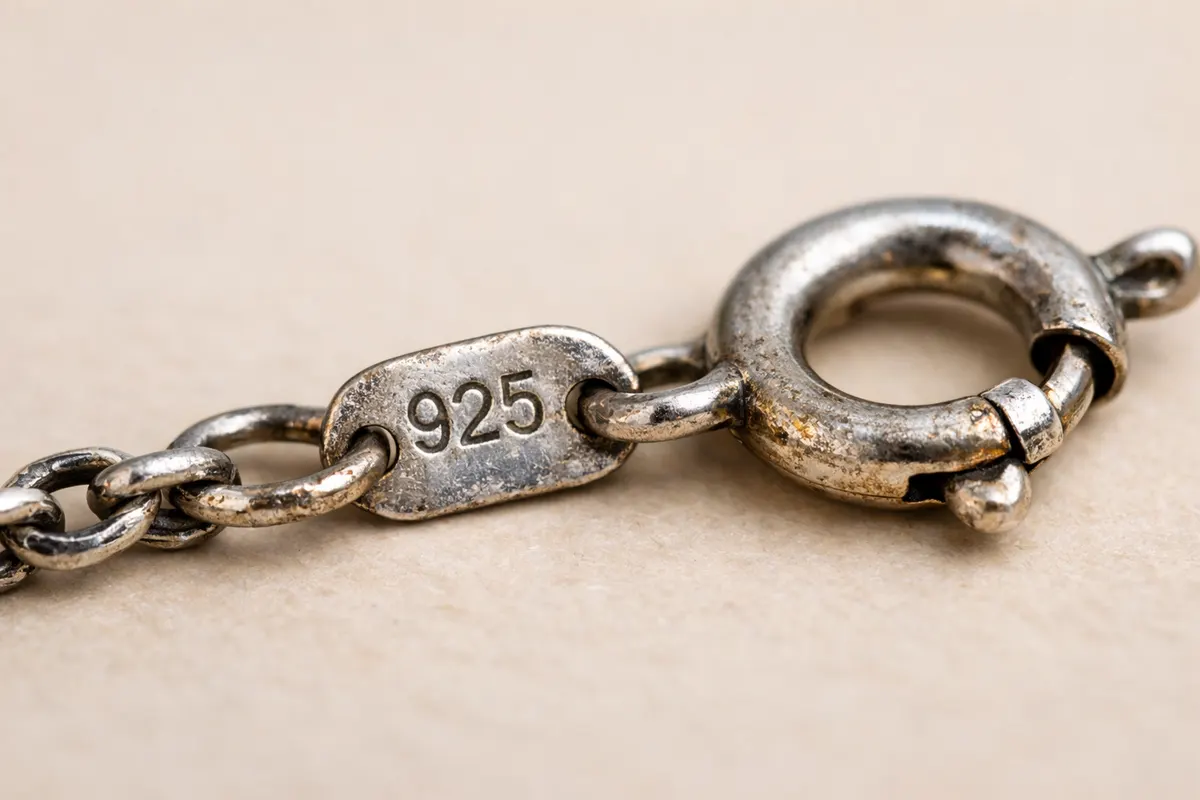
Quick answer for what does 925 mean on jewelry
What does 925 mean on jewelry? A clear '925' or '. 925' stamp usually indicates the piece was made of sterling silver, an alloy with roughly 92.5% silver and 7.5% other metals. On well-made items the stamp is one of the manufacturer’s hallmarks and helps you separate likely sterling from costume pieces.
A photo of a 925 stamp is a strong visual clue when the mark is crisp, placed in a conventional location (inside a ring shank, on a clasp or on a flat panel), and surrounded by consistent metal color without obvious base-metal exposure. That said, a stamp alone does not guarantee purity, value, or authenticity: stamps can be added, altered, or applied to plated items.
Treat the stamp as the starting point. After you read the mark, check nearby construction details—solder seams, clasp type, wear at high-contact spots, and any secondary hallmarks. Those combined clues make a photo far more useful than the stamp by itself and suggest whether professional testing is needed.
Strongest visual clues
Start with the stamp itself. A deep, well-formed '925' stamped into a hard area of the piece (inside a ring shank, on the underside of a pendant bale, or on the flat of a clasp) is a much stronger signal than a light surface engraving. Look for consistent stroke depth and crisp edges: pressed hallmarks from factory dies tend to have repeatable shape and spacing.
Check placement and context. Sterling marks are usually grouped with other hallmarks—maker’s initials, a country mark, or a purity number like '. 925'. A stamp located in a sensible spot (near a soldered join or inside a band) and accompanied by a maker mark raises confidence. A random, poorly placed stamp on a surface prone to polishing or plating is less reliable.
Inspect wear areas where plating would fail first: the inner shank of rings near knuckles, the underside of bangles where skin oils abrade metal, and the tips of clasps or jump rings. If the metal beneath looks the same color as the stamped area and there’s no darker base metal showing, that supports the stamp’s claim. Look specifically for narrow lines of exposed base metal at bends or where two parts rub together.
Examine construction details. Well-made sterling commonly uses solid solder joins, neatly filed seams, and certain clasp styles (boxed or hollow-snap clasps on heavier pieces; spring rings and lobsters on lighter chains). Thin sheet construction with crude solder or visible base-metal cores around cut edges is a red flag for plated or non-precious pieces.
Look for companion marks. Words like 'STERLING,' numeric variants like '925/1000' or '. 925' and maker initials provide context. Multiple consistent marks are harder to fake convincingly in the same area, because they require extra tooling and correct placement—so they increase confidence from a single photo.
- Stamp clarity: deep, crisp impressions (best evidence within a photo).
- Stamp context: nearby maker marks or '. 925' variants strengthen the cue.
- Wear patterns: consistent metal color at high-friction spots supports solid silver.
- Solder and joins: smooth, well-blended solder is typical of solid precious-metal work.
- Clasp and hardware: certain clasp styles and chain finishes match genuine sterling construction.
Weak signals
Color alone is an unreliable signal. Phone cameras, lighting temperature, and reflections can make base metals look silvery or change the apparent contrast between plated and solid metal. Bright, white-looking metal in a photo might be plated rhodium or nickel silver beneath a reflective finish.
Glare and specular highlights will hide details. A shiny surface can wash out a shallow stamp or obscure thin plating lines. Photos taken at a single high-angle light source often hide seams, tiny exposed base-metal spots, and texture differences that reveal plating.
One mark without context is weak. A small '925' stamped on a plated surface can be intentionally added to deceive or copied from another piece. Laser-etched tiny marks and faint ink stamps are easier to fake than pressed hallmarks. If you only have one cropped photo of a stamp, you can’t reliably separate genuine sterling from a plated lookalike.
Generic stylistic cues—like an ornate filigree or polished finish—do not prove silver. Many costume manufacturers copy sterling styles and finish work to mimic higher-end jewelry. Those visual echoes are common and can mislead collectors or buyers looking only at a single image.
- Color and white balance: camera settings can make plated pieces look like silver.
- Single-angle photos: miss seam details and areas where plating wears off.
- Shallow or aftermarket stamps: easily added to plated goods.
- Stylistic mimicry: design alone doesn’t confirm metal or maker.
Comparison workflow
Work through a short checklist for any piece before you assume the stamp is definitive. First, photograph the stamp and the immediate area at 2–3 angles with a steady hand and diffuse light. One straight-on macro of the mark and one oblique view showing the surrounding metal will reveal depth, placement, and nearby wear.
Second, photograph high-wear spots: the inner shank of rings, the undersides of bracelets, the edges of clasps, and jump rings. Look for color changes, tiny exposed cores, and different patina. If those wear points match the stamp area in color and texture, the evidence favors solid silver.
Third, inspect construction details against known examples. Compare the shape of solder fillets, the finish of cut edges, and the clasp design to reference photos of authentic sterling pieces from reputable makers. Heavy, well-finished solder and neatly finished inside surfaces are typical of genuine silver, while rough solder and visible base-metal cores often indicate plated or inexpensive construction.
Finally, combine the visual evidence with practical checks you can do without lab tools: a lightweight sterling ring will still feel denser and more balanced than thin gilt pieces; heavier sterling chains have consistent link finishing inside and out. Use the combined photo record to decide whether you need a professional test—acid testing, XRF, or a jeweler’s appraisal—especially for items with ambiguous wear or high value.
- Photo checklist: macro stamp, oblique context, wear areas, clasp/joins.
- Visual match: compare solder, edge finishing, and clasp type to sterling examples.
- Wear check: consistent color at friction points supports the stamp.
- Decision trigger: if pictures show contradictory clues, plan professional testing.
App workflow
After you complete the visual checklist, use Jewelry Identifier as a first-pass analysis tool. Start by taking clear photos that include the stamp, a close-up of any wear, and an image showing construction features like the clasp, solder joints, and inside surfaces. Good photos make automated suggestions and human reviews far more accurate.
When you run the piece through the app, treat the results as guidance rather than proof. The app can help surface likely construction matches, common hallmarks, and plating indicators based on the images you provided. Combine that output with your own wear and construction observations before making decisions about purchase, sale, or testing.
If the app highlights inconsistencies—such as a crisp '925' stamp on a piece where the wear areas reveal a different base metal—use that as a cue to get a hands-on check. For items of potential value or historical interest, a jeweler who performs acid or XRF testing can confirm alloy content reliably; the app is most helpful for narrowing which pieces need that step.
- Capture: stamp close-up, wear points, full-piece context, and clasp detail.
- Interpret: use app suggestions alongside observed construction clues.
- Next steps: order professional testing when app and photo clues disagree.
Related guides
Run a quick check with Jewelry Identifier
After you photograph the stamp, wear spots, and clasp, open Jewelry Identifier to get a first-pass read on construction and likely matches. Use the app’s suggestions together with the visual checklist above to decide whether the piece needs professional testing or appraisal.
Take the next step →Frequently asked questions
Does a 925 stamp guarantee the jewelry is sterling silver?
No. A '925' stamp indicates the piece is purportedly sterling silver, but stamps can be added to plated pieces or falsified. The mark increases the likelihood the maker intended sterling, especially when accompanied by other hallmarks and correct construction, but only metal testing (acid test or XRF) or a trusted jeweler’s inspection can confirm alloy purity.
What visual signs show a plated item rather than solid sterling?
Common visual signs of plating include a different-colored core revealed at cut edges or bends, narrow lines of base metal at high-wear points (ring shank near the knuckle, inside bracelet edges, clasp tips), and uneven wear where the bright surface peels or flakes. In photos, look for sudden color transitions at joins or where two parts rub together.
Is '. 925' different from '925' or 'sterling' in meaning?
No—'. 925', '925', and 'sterling' all indicate the same conventional silver purity level: 92.5% silver with the remainder typically copper or another alloying metal. The different formats are regional or stylistic variations of the same hallmark. The presence of a variant doesn’t change whether the piece is genuine; context and construction still matter.
Can I rely on a phone photo alone to value or authenticate a piece?
Relying on a single phone photo is risky. Photos are excellent for initial identification and for spotting obvious mismatches between stamp and wear, but they cannot prove market value, exact alloy percentages, or historical authenticity. For high-value items, visible inconsistencies, or any transaction where accurate grading matters, follow up with hands-on testing or a professional appraisal.