Entity knowledge page
Amethyst: Identification, Value, and Real Examples
A practical amethyst guide: learn what it is, photo-checkable ID clues, typical resale ranges, common lookalikes, and safe next steps for verification.
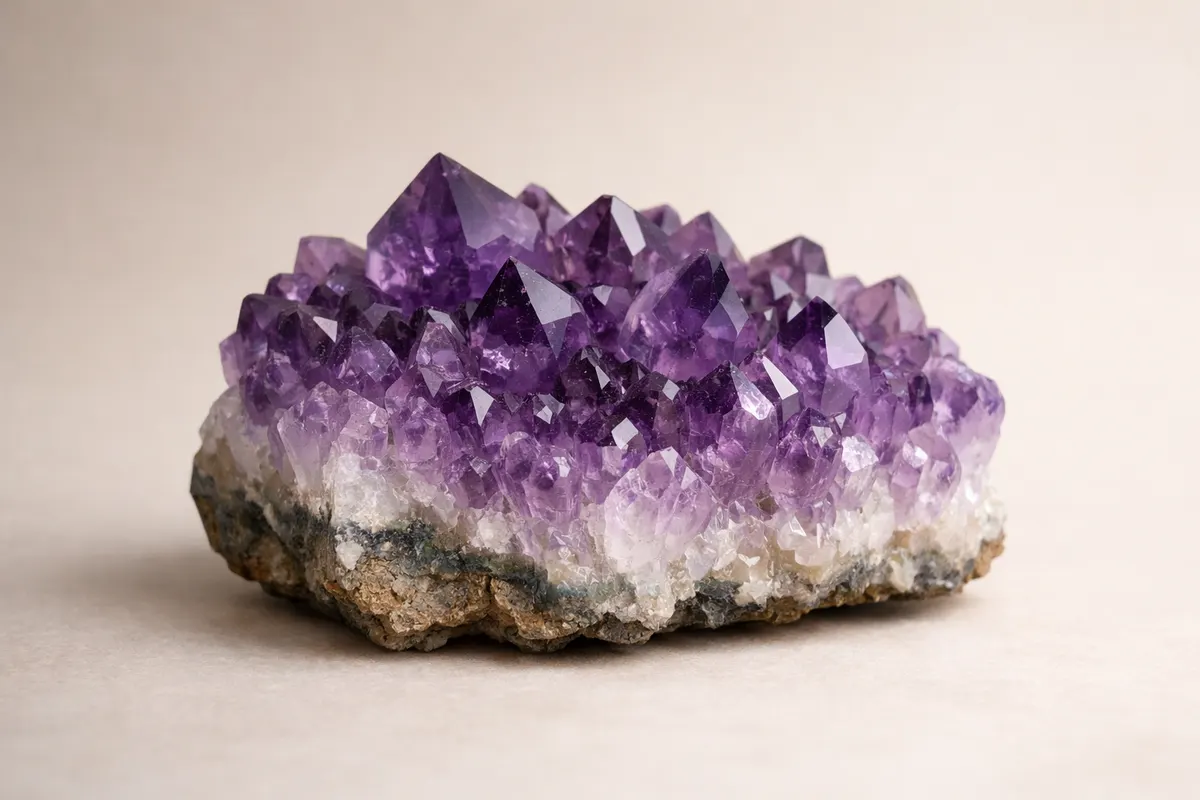
What amethyst is and where it comes from
Amethyst is the purple variety of quartz (silicon dioxide) colored primarily by trace iron and natural irradiation. It forms as crystalline bands inside geodes, as well as facetable crystals cut for jewelry. Major commercial sources include Brazil, Uruguay, Zambia, and parts of Russia; each region produces slightly different hues and zoning patterns.
In jewelry, amethyst is commonly cut as faceted stones (ovals, cushions, and emerald cuts), cabochons, and beads. Because quartz has a Mohs hardness of about 7, amethyst is reasonably durable for everyday wear but is softer than corundum (sapphire/ruby) and requires standard care to avoid surface abrasion.
Collectors and jewelers distinguish amethyst by color, clarity, and size: deep, evenly saturated purple with flashes of red or blue tends to be most desirable. Many commercial beads and set stones are heat-treated or mixed with other quartz varieties; the presence of heat-treated or synthetic stones is common in the market.
How can you tell if a stone is amethyst?
Photos can reveal useful signals that point toward amethyst, though images alone usually cannot prove authenticity. Key visible clues include purple-to-reddish-violet hue, uneven color zoning (banding or patches), and crystal shapes when the specimen is rough. Natural amethyst often shows color concentration at the crystal tips or along growth bands.
When examining close-up photos, look for natural inclusions such as thin needle-like or liquid inclusions, small two-phase (liquid + gas) cavities, and growth zoning. By contrast, purple glass typically shows round air bubbles and curved flow lines; those are clear indicators of a manmade glass simulant in macro images.
Lighting and angle series are very helpful. Document the stone in bright daylight (diffuse), warm indoor light, and rotated views. Some lookalikes shift color under different angles (strong pleochroism is not a feature of quartz), so a consistent purple under rotation supports amethyst but does not confirm it.
- Photograph a well-lit top view (table) and a profile to show the pavilion and culet.
- Include a macro image focused on any inclusions or internal features.
- Take photos in daylight and incandescent light to show color stability.
- Place a small ruler or coin in the frame for scale and note approximate carat size if known.
Key facts about amethyst
The table below summarizes the technical attributes that matter for identification, care, and value. These are measurable properties; some require tools (refractometer, specific-gravity kit) and professional testing for conclusive results.
Use the attribute table to compare against visible clues from photos. For casual sellers and buyers, combining the photo checklist with a simple in-person test (weight, heft, and a professional refractive-index check) gives a much stronger indication than photos alone.
| Attribute | Detail |
|---|---|
| Composition | Silicon dioxide (quartz) colored by iron + irradiation |
| Hardness | Mohs 7 — resists light scratches but not as hard as sapphire |
| Refractive index | Approx. 1.544–1.553 (requires refractometer) |
| Specific gravity | About 2.65 |
| Common forms in jewelry | Faceted stones, cabochons, beads, geode slices |
| Identifying marks | Natural growth zoning and inclusions; no metal hallmark on the stone |
| Care sensitivity | Can fade with prolonged sunlight and may darken or change with heating |
Amethyst resale value tiers
Values on the secondhand market vary widely. Most amethyst sold as jewelry is common and modestly priced, while unusually large, deeply saturated, and eye-clean stones from coveted localities command higher premiums. These ranges are generalized resale guidance — they are not appraisals and cannot replace professional valuation for high-value items.
Smaller fashion jewelry pieces with amethyst centra generally trade for modest totals; per-carat pricing applies more to loose stones. Location, cut quality, color saturation, and presence or absence of heat treatment are the primary drivers. Stones with deep, velvety purple and minimal zoning tend to be the most desirable to collectors.
| Tier | Typical resale per carat (USD) | Common form | What drives price |
|---|---|---|---|
| Low / commercial | $1–$6 | Mass-market beads, small set stones | Pale color, heavy zoning, visible inclusions |
| Mid-grade | $6–$25 | Faceted gems in retail jewelry | Even color, decent clarity, common sizes |
| Fine | $25–$75 | Large faceted stones, designer settings | Deep, even purple; eye-clean; good cut |
| Top / collectible | $75–$250+ | Museum-quality specimens and rare large cuts | Exceptional color saturation, provenance, large size |
Gems and materials commonly confused with amethyst
Amethyst is most often mistaken for purple glass, dyed quartz, and some purple gem materials like purple spinel or iolite. Photos can reveal tell-tale differences for each—look for bubbles and flow lines for glass, unusually uniform color for dyed material, and color-shift behavior for pleochroic gems like iolite.
Lab-grown quartz is chemically the same as natural amethyst and can be visually identical in photos; the distinction requires provenance or laboratory testing. If you suspect a highly clean, flawless purple stone, consider the possibility of lab-grown material or glass rather than natural amethyst.
- Purple glass: look for round bubbles, curved flow lines, and unusually high brilliance relative to inclusions.
- Dyed quartz or agate: often shows dyed concentrations near fractures or along grooves; color may sit on the surface.
- Iolite: shows strong color change or pleochroism (blue-violet to gray), visible when the stone is rotated.
- Synthetic quartz (hydrothermal): very clean, often with characteristic growth zoning visible under magnification.
Caring for amethyst jewelry
Avoid prolonged exposure to direct sunlight or intense UV sources—lighter amethysts are most susceptible to fading over long periods. Also avoid exposing amethyst to high heat; heating can change its color (often to yellow or brown), a process used commercially to produce citrine.
Clean amethyst with warm water, mild soap, and a soft brush. Ultrasonic cleaners are usually safe for clean, intact stones but should be avoided for heavily included stones or pieces with fractures. Store amethyst separately from harder gems to prevent surface scratches.
- Routine cleaning: warm soapy water and soft brush, then dry with a lint-free cloth.
- Avoid bleach, strong acids, and prolonged hot conditions.
- For valuable pieces, seek professional cleaning and a lab report before any heat-based treatment.
Frequently asked questions
Is amethyst a real gemstone or just dyed glass?
Amethyst is a genuine gemstone: a purple variety of quartz colored by iron and natural irradiation. Dyed glass or treated materials exist and can imitate amethyst, but natural amethyst shows characteristic growth zoning and inclusions that differ from glass bubbles and flow lines.
Can you tell if an amethyst is real from a photo?
Photos can show signs that support an amethyst ID—color zoning, natural inclusions, and consistent purple hue across angles—but images alone rarely prove natural origin. Use photos as a first pass, then confirm with in-person tests (refractive index, specific gravity) or a lab report for high-value items.
Does amethyst lose color over time or with sunlight exposure?
Prolonged exposure to strong sunlight or UV can fade lighter amethyst over months to years; darker, well-saturated stones are less likely to show noticeable fading. To preserve color, store pieces out of continuous direct sun and remove jewelry for extended outdoor exposure.
Are citrine and amethyst related?
Yes. Citrine is also a variety of quartz. Heating amethyst can produce citrine-like yellow or orange tones, and many commercial citrines are heat-treated amethyst. That change is irreversible and affects value and classification, so sellers often disclose heat treatment when known.
Related guides
Compare your stone against amethyst clues
Photograph your piece following the photo checklist on this page—table, profile, close-up of inclusions, and daylight vs warm light views—then use the jewelry-identifier.app mobile app to compare those images against common amethyst clues. Treat the app as a careful first pass: it can highlight likely matches and lookalikes, but for high-value items or remaining doubts seek an in-person gemological check or lab report.