

Jewelry Identification
Bakelite: Identification, Value, and Real Examples
Learn which visible clues point to bakelite jewelry, how to check them from photos, and realistic secondhand value ranges before seeking verification.
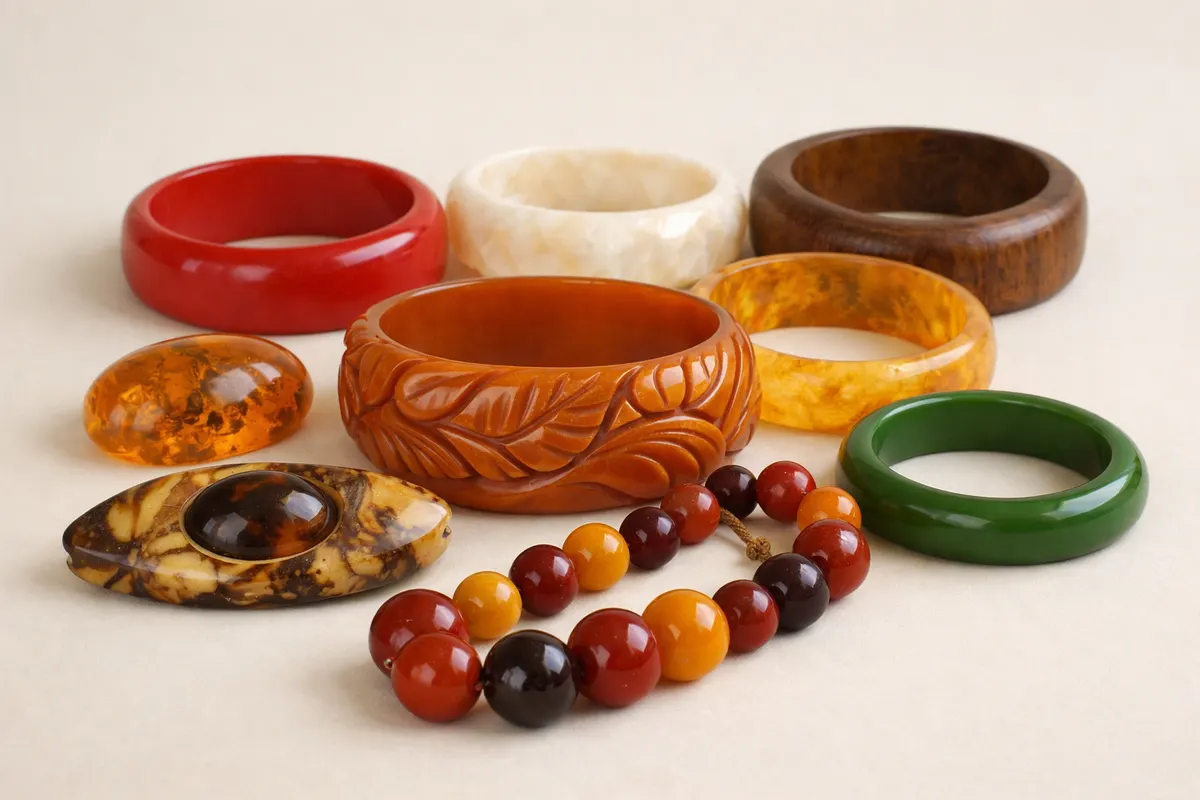
What bakelite is and where it appears in jewelry
Bakelite jewelry refers to pieces made from an early plastic—phenol-formaldehyde resin—first commercialized in the early 20th century. It was widely used for costume jewelry, beads, buttons, bangles, and compact housings because it could be molded in vivid colors and polished to a hard shine. When collectors talk about "bakelite," they usually mean jewelry and accessories made roughly between the 1920s and 1950s.
Manufactured bakelite takes distinctive colors and patinas. Early pieces often show deep, saturated hues like butterscotch amber, apple-green, and cherry red; later production added marbled and Catalin-style swirls. The material is dense but lighter than glass, and it polishes to a warm, almost oily sheen when genuine.
Attribution matters: maker marks are uncommon on mass-market bakelite, so construction clues—pin backs, bead drill holes, and age-appropriate clasps—are often the best evidence a photo can show. These contextual details help separate a plausible period piece from later plastic reproductions.
How can you tell if bakelite jewelry is real?
Photos can reveal many useful clues, though no single picture proves authenticity. Look for characteristic surface wear: genuine bakelite often develops a fine, slightly matte patina on high points, with microscopic crazing or tiny surface nicks that polish out to a warm glow. Hard gloss across an entire surface with no micro-wear can be a red flag for later plastic.
Color behavior under white light is a strong photo-checkable signal. Solid, opaque pieces in deep butterscotch-to-amber tones are common; marbled or swirling patterns appear on Catalin-style pieces. Backlighting a bead or thin pendant in a photo may show a slightly translucent edge in warm tones—this band of light is typical for older phenolic resins and helps rule out many modern plastics.
Construction and hardware speak to age. Examine clasps, pin stems, bead drill holes and how pieces are strung. Older bakelite bracelets often show drilled holes with slight chipping and rounded edges from hand tooling; clasps and pin backs from the 1930–50s have era-appropriate soldering marks and patina. A modern spring-ring clasp or bright, perfectly uniform drilling suggests a newer replacement or reproduction.
Simple at-home checks you can illustrate in photos: non-magnetic behavior (bakelite is not magnetic), the absence of molded maker marks (bakelite rarely bears small manufacturer stamps), and a dense but lightweight look compared with glass. Avoid definitive statements from a single photo—these signals build a probability, not proof.
- Surface: warm, slightly oily luster with micro-wear or tiny crazing lines
- Color: deep butterscotch, cherry red, olive green, or marbled Catalin patterns
- Edges/backlighting: thin translucent rim visible when lit from behind
- Hardware: age-appropriate clasps, drilled holes with chatter marks
- Weight: dense for plastic but lighter than glass; not magnetic
Bakelite key facts and quick specs
The table below summarizes the most useful technical and photographic facts collectors and buyers check when evaluating bakelite jewelry. These rows focus on attributes you can often confirm or strongly suspect from clear photos and short descriptions.
Use these specs as a checklist when comparing pieces: color, translucency, signs of age on hardware, and documented provenance are all stronger together than any one feature alone.
| Attribute | Typical value | Photo-checkable clues |
|---|---|---|
| Composition | Phenol-formaldehyde resin (early thermoset plastic) | Opaque or slightly translucent edges; warm surface sheen |
| Hardness | Hard, brittle compared with modern ABS plastics | Chips with small, sharp fractures; no flexing in photos |
| Color range | Butterscotch, amber, red, green, black, marbled Catalin | Saturated tones; visible swirls or layered color bands |
| Common marks | Usually none; occasional maker labels or paper tags | Absence of small molded logos; look for old paper labels or stamps on hardware |
| Typical settings | Beads, bangles, brooches, buttons, compact housings | Era-appropriate clasps, hand-drilled beads, soldered metal backs |
| Care sensitivity | Sensitive to solvents and high heat | Surface crazing, flaking paint, or softened edges in poor-condition photos |
What bakelite jewelry typically sells for
Resale value for bakelite jewelry varies widely and depends on condition, color, rarity, and provenance. Prices in secondhand markets reflect demand from collectors and the piece’s visual appeal; a single photograph can help estimate likely tiers but cannot replace an in-person appraisal or lab test.
Condition and color are the dominant drivers. Butterscotch bangles in excellent condition and rare Catalin marbled patterns command the highest interest. Conversely, chipped, heavily cleaned, or chemically damaged pieces lose substantial resale value even if they are period-correct.
| Tier | Typical secondhand range | What drives price |
|---|---|---|
| Entry | $10–$40 | Mass-produced beads or damaged small items; common colors and heavy wear |
| Mid | $40–$200 | Complete bracelets, brooches or matched bead strands in fair to good condition |
| High | $200–$1,500 | Rare colors (deep butterscotch, cherry red), good condition, desirable sizes |
| Exceptional | $1,500+ | Museum-quality sets, documented provenance, unusual designer or pattern |
Materials bakelite is commonly confused with
Several later plastics and materials mimic the look of bakelite; photos can often separate them if you know what to look for. Catalin is related chemically and is a colorful phenolic resin produced post-1930s with brighter, more translucent marbling; collectors make a distinction by finish and translucency.
Casein and cellulose nitrate (early plastics used for jewelry) can show similar patina but tend to be softer or more reactive to solvents. Modern thermoplastics such as Bakelite-look acrylics and nylon beads often have perfectly uniform color, very sharp mold lines, or modern clasps that betray a reproduction.
Lookalikes also include glass and tortoiseshell. Glass beads are heavier and show perfect clarity or internal bubbles, while tortoiseshell has organic grain and flexes slightly compared with rigid phenolic resin. When a photo leaves doubt, note the specific differences below to guide further checks.
- Catalin: brighter marbling and higher translucency; check edge translucence in photos
- Casein/celluloid: softer, may show heat damage or solvent reactions not typical for bakelite
- Modern acrylics: uniform color, mold seam clarity, modern hardware
- Glass/tortoiseshell: weightier glass reflections or organic grain and flexibility
Care for bakelite jewelry
Bakelite is sensitive to strong solvents, high heat, and abrasive cleaners. In photos you can spot over-cleaned pieces by a loss of surface warmth or uneven sheen where someone has aggressively polished a chip to remove dirt.
For handling, avoid ultrasonic cleaners and chemical dips. Use a soft, dry cloth for light cleaning and a slightly damp cloth for sticky grime; dry immediately. Store pieces away from prolonged sunlight to limit color shift and avoid rubber or PVC contact, which can degrade the surface over time.
- Avoid solvents and abrasive polishes; never use acetone or paint strippers
- Clean with a soft cloth and mild soap solution if needed; dry quickly
- Store in a cool, dark place away from PVC and rubber to prevent deterioration
Frequently asked questions
Can you authenticate bakelite from a single photo?
A single photo can provide strong visual clues—color, wear patterns, edge translucency, and hardware age—but it cannot definitively authenticate bakelite. Photos increase confidence when multiple period-consistent signals align, yet lab testing or physical inspection remains the only way to confirm material composition.
How can I tell bakelite from Catalin in pictures?
Catalin tends to be brighter and more translucent with sharper marbling; bakelite often has a warmer, more saturated but slightly opaque look. In photos, backlit edges that glow warmly and a deep, oily surface sheen favor bakelite, while vividly translucent marbling suggests Catalin.
Are certain bakelite colors worth more?
Yes. Deep butterscotch, apple-green, cherry red and unusual marbled patterns typically attract higher prices. Rarity, size, and condition matter too: an intact large bangle in a rare color will usually sell for significantly more than small or damaged items in common shades.
What should I do if a photo raises doubts about authenticity?
Document the piece with clear photos of edges, hardware, drill holes, and any labels, then compare those details against trusted references. As a practical next step, consider the Jewelry Appraisal: Visual Clues guide on Jewelry Identifier for framing your evidence, or use the Jewelry Identifier tool to compare a photo against typical bakelite clues before pursuing professional lab tests.
Related guides
Compare your photo to bakelite clues
If your photos show the characteristic color, edge translucency, or era-appropriate hardware described here, the Jewelry Identifier tool can help you compare those visual signals with known bakelite examples. Use it as a first-pass check to prioritize pieces for closer inspection or professional testing. Visit https://jewelry-identifier.app/tools/jewelry-identifier to compare a photo of your piece to bakelite clues and see which next verification steps make sense; remember that a photo-based comparison increases confidence but does not replace lab authentication.
Take the next step →