

Diamond Identification
Moissanite: Identification, Value, and Real Examples
A practical moissanite guide: what it is, visible characteristics to check in photos, common lookalikes, care, and cautious resale value estimates.
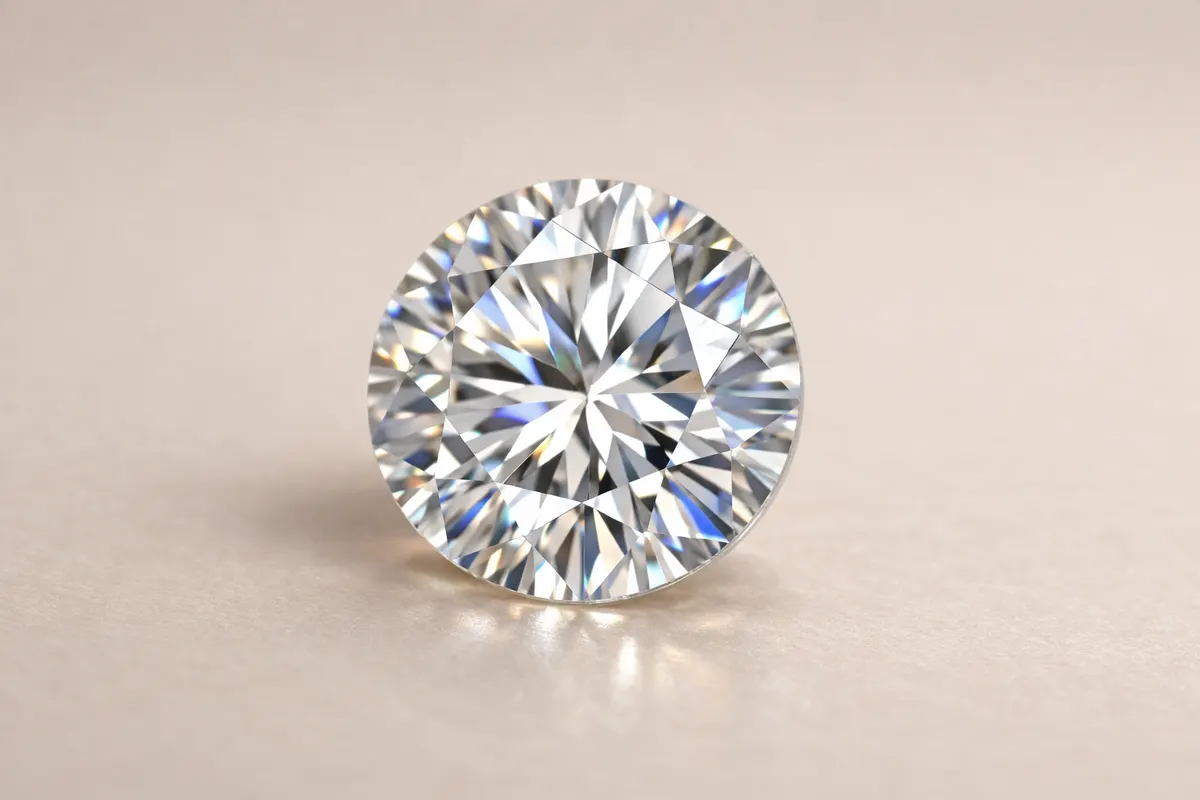
What moissanite is and how it's used in jewelry
Moissanite is silicon carbide (SiC), a hard, brilliant gemstone most commonly produced in laboratories for jewelry. Natural moissanite is vanishingly rare, so virtually all pieces on the market are lab-grown and intentionally cut to compete with diamonds as center stones, accents, and melee.
Because moissanite has a higher refractive index than diamond, it shows pronounced dispersion or 'fire'—colorful flashes of light—alongside strong white sparkle. Jewelers use it in engagement rings, halo settings, and fashion jewelry where the buyer wants diamond-like brilliance at a lower cost per carat.
Physically, moissanite is durable (hardness around 9.25 on the Mohs scale) and resists everyday wear, though its optical behavior differs from diamond in ways that trained eyes and certain testers can detect. This page explains the visible signals you can check in photos and the limits of photo-based ID.
- Composition: silicon carbide (SiC), typically lab-grown for jewelry
- Common uses: center stones in rings, accent stones, and larger fashion pieces
- Optical signature: very high brilliance and colorful dispersion (more fire than most diamonds)
- Durability: hard and wearable, but optically distinct from diamond
How can you tell if a stone is moissanite from a photo?
Photos can reveal strong clues but rarely provide absolute proof. Start with overall sparkle: moissanite tends to return more colorful rainbow flashes in flash or sunlight photos than diamonds, which typically show whiter scintillation. If a ring photo taken in bright light shows unusually vivid rainbow flashes from many facets, that favors moissanite.
Look for facet doubling under magnification or high-resolution close-ups. Moissanite is doubly refractive, which can make facet edges or facet junctions appear doubled at certain angles. Diamond is singly refractive and will not show this doubling. If you can clearly see doubled facet lines in macro photos, treat that as a strong visual signal for moissanite.
Check the setting and wear patterns in photos. Moissanite is slightly less dense than diamond, so for the same dimensions it will weigh a bit less—irrelevant for most photos but relevant when paired with documented carat/measurements. Also note the stone’s color: many early moissanites have a faint warm or greenish tint off-angle; modern 'near-colorless' grades are closer to diamond but may still show subtle differences in daylight photos.
Avoid relying on single indicators. Thermal diamond testers and many smartphone apps can be fooled by moissanite. Use a checklist of photo-checkable clues (fire, facet doubling, color cast, and setting style) and treat the result as provisional until a hands-on test or lab report can confirm identity.
- Colorful rainbow flashes in flash/sunlight photos often point to moissanite
- Doubled facet edges in macro photos are a strong visual signal for moissanite
- Noticeable warm or greenish tint off-angle can indicate older moissanite formulations
- Provenance clues: modern branded settings and low retail price together increase the chance of moissanite
Moissanite key facts at a glance
The table below summarizes the core physical and jewelry-related attributes to keep in mind when comparing moissanite to other stones in photos or listings. These are practical reference points for visual checks and basic conversations with buyers, sellers, or appraisers.
Remember that optical behavior (refractive index, dispersion, and birefringence) is what most reliably separates moissanite from diamond in photo and loupe views; hardness and composition explain durability and care differences.
| Attribute | Typical moissanite detail | Why it matters for photos or jewelry |
|---|---|---|
| Composition | Silicon carbide (lab-grown) | Different mineral chemistry from diamond; explains optical differences |
| Mohs hardness | ~9.25 | Very durable for daily wear, but slightly softer than diamond |
| Refractive index | Higher than diamond (creates strong 'fire') | Produces vivid colorful flashes visible in many photos |
| Birefringence | Noticeable (doubling of facets in magnified views) | Facet doubling is a clear loupe/photo clue distinguishing it from diamond |
| Common settings | Prong rings, halos, pendants, stud earrings | Often sold in diamond-style settings—check setting quality vs stone price |
| Marks/inscriptions | None on stone; settings may have maker's marks | Photos of hallmarks can help verify setting but not stone identity |
- Use the hardness and refractive index lines to set expectations about durability and sparkle
- Common settings include prong rings, halos, and pavé—similar to how diamonds are set
- There are no standard factory inscriptions that identify moissanite on the stone itself
What moissanite is worth on the secondhand market
Moissanite resale values are much lower than diamonds of similar apparent size. Secondhand prices depend on size, cut quality, brand (branded designer stones can command a premium), and the metal or setting included in the sale. Use the table below as a cautious guide to typical secondhand sale ranges you might expect online or at consignment.
These ranges are illustrative, not appraisal figures. They reflect common marketplace listings and private-sale outcomes; actual sale prices vary by buyer demand, listing quality (photos and descriptions), and the presence of accessories or original purchase documentation.
| Tier | Typical secondhand range (USD) | What most affects price |
|---|---|---|
| Small melee/accents (<0.10 ct each) | $5–$35 per stone or modest markup as part of finished jewelry | Quantity, whether sold loose or within a setting |
| Small single stones (0.25–0.49 ct) | $30–$150 | Cut quality, visual color, and seller presentation |
| Common center sizes (0.50–1.49 ct equivalent) | $80–$600 | Cut, brand, and whether sold as part of a ring or loose stone |
| Large stones (1.5+ ct equivalent) | $300–$1,500+ | Rarity of size, cut symmetry, and market demand |
- Smaller melee pieces and factory-set accents usually have modest resale value
- Larger, high-quality cuts in branded settings hold more buyer interest and can fetch higher prices
- Condition of the setting and documentation (receipt, original box) materially affects realized resale price
Stones moissanite is most often mistaken for
Moissanite is most frequently confused with diamond and cubic zirconia (CZ); white sapphire also appears in some comparisons. Photos can often separate these lookalikes by focusing on specific optical cues and inclusions.
Diamond: Diamonds show less colorful dispersion and do not exhibit facet doubling. In high-quality photos, diamonds tend to return whiter scintillation rather than the rainbow fire typical of moissanite. If a macro image shows doubled facet junctions or very strong multi-colored flashes, moissanite is likelier than diamond.
Cubic zirconia (CZ): CZ often looks 'too perfect'—very large, broad flashes and softer facet edges in close-up photos. CZ is also softer and can show surface wear or rounded facet edges over time. Additionally, CZ sometimes exhibits tiny gas bubbles visible under magnification, whereas moissanite and diamond rarely do.
White sapphire: Sapphires have lower refractive index and therefore less fire; they often appear slightly more 'glassy' or pearly in photos. If a light-source photo shows subtle grayish luster and few colorful flashes, consider sapphire as a candidate rather than moissanite.
- Diamond: look for white sparkle, no facet doubling, and absence of vivid rainbow fire
- Cubic zirconia: look for overly broad colorful flashes, rounded facet edges, or visible bubbles
- White sapphire: lower fire and softer pearly luster in photographs
Care and handling for moissanite jewelry
Moissanite handles everyday wear well. Routine cleaning with warm water, a mild dish soap, and a soft brush will restore brilliance after skin oils or lotions dull the surface. Rinse thoroughly and dry with a lint-free cloth to avoid water spots in photos.
Ultrasonic and steam cleaners are generally safe for moissanite stones themselves, but caution is needed if the piece contains fragile settings, glued elements, or other gemstones that could be damaged. If you see loose prongs, have a jeweler tighten them before using aggressive cleaning methods.
Because moissanite produces strong colorful flashes, photographing a freshly cleaned stone improves identification and resale listings. When storing moissanite, keep it separate from softer stones to avoid scratching metal or other gems.
- Clean with warm soapy water and a soft brush; rinse and dry fully
- Avoid harsh abrasives that might dull metal or damage other gemstones
- Check prongs regularly and get professional tightening if needed
Frequently asked questions
Is moissanite a real diamond?
No. Moissanite is a different mineral—silicon carbide—not a diamond. It looks similar to diamond to many observers because it’s cut and polished like diamond, but it has distinct optical properties (stronger fire, birefringence) and a different chemical composition.
Can you tell moissanite from diamond without specialized tools?
You can gather strong clues from photos: moissanite often shows vivid rainbow flashes, and high-resolution close-ups may reveal doubled facet lines. However, visual checks are provisional. For confirmation, a hands-on gemologist evaluation or lab report is needed because certain tests and instruments provide definitive identification.
Will a diamond tester mistake moissanite for a diamond?
Many traditional thermal diamond testers can misidentify moissanite as diamond because moissanite conducts heat differently but can still register similarly. Newer testers and electrical conductivity devices, or professional gemological analysis, are better choices for accurate identification.
Can moissanite be resold and what affects its resale value?
Yes, moissanite is resold on secondary markets. Resale value depends on apparent size, cut quality, brand and documentation, setting quality, and presentation. Generally, expect considerably lower resale prices than diamonds of similar appearance; clear photos, accurate descriptions, and original purchase details help achieve better secondhand prices.
Related guides
Compare your photo to moissanite clues with Jewelry Identifier
After you check the visible clues above, use the Jewelry Identifier app to run a first-pass comparison of your piece against the moissanite signals described here. The app can highlight photo-based indicators such as fire patterns and facet details, but it does not replace hands-on testing or a lab report—treat results as an informed starting point for next steps.
Take the next step →