

Pearl Identification
Pearl: Identification, Value, and Real Examples
Discover which photo-visible clues help answer how to tell if pearls are real, what limits remain, and safe next steps before relying on an identification.
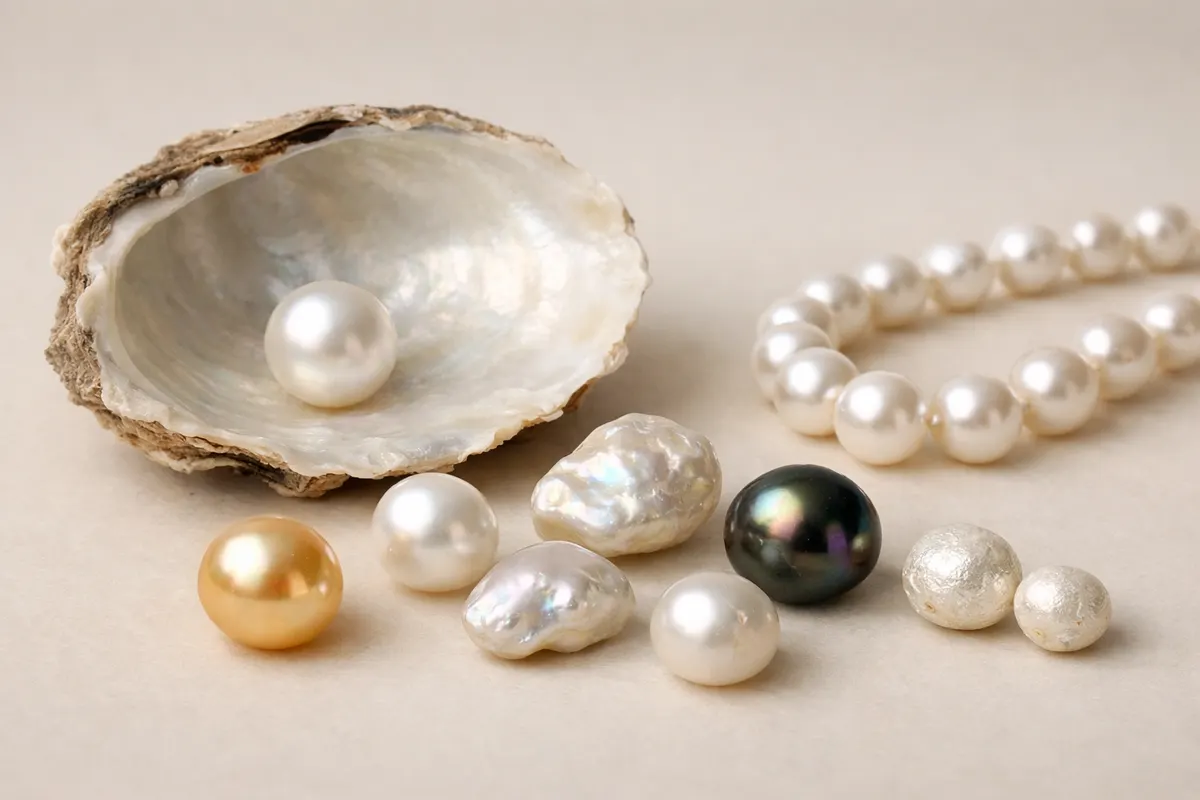
What a pearl is and how it’s used in jewelry
A pearl is a hard, rounded object produced by mollusks when layers of nacre (aragonite platelets and organic matrix) are secreted around an irritant or implanted nucleus. Pearls appear as single beads (drops, baroque shapes) or as matched strands and are one of the oldest gemstones used in jewelry.
In modern markets most pearls worn as necklaces are cultured: a bead or tissue is placed inside an oyster or mussel and the animal deposits nacre around it. Natural pearls, made without human intervention, are far rarer and usually command higher prices when verified.
Pearls are valued for size, luster (the sharpness and depth of reflected light), surface condition, shape, and color overtones. They are commonly set as single-drop pendants, matched strands, or accent beads in bracelets and earrings; strand construction (knotted between beads) is a common quality signal.
- Composition: layers of nacre (calcium carbonate + conchiolin) grown by mollusks.
- Common types: freshwater cultured, Akoya, South Sea, Tahitian, and natural pearls.
- Typical jewelry uses: knotted strands, stud/drop earrings, pendants, and bead bracelets.
How can you tell if pearls are real from photos?
Photos can show several reliable visual clues that point toward real pearls: high, mirror-like luster with layered reflections; subtle surface texture and tiny pits; gentle color overtones; and slightly varying shapes and sizes across a strand. Look for depth in highlights (a multi-layered reflection) rather than a single bright spot.
Zoomed-in images of drill holes and bead edges are especially useful. Real pearls typically show concentric layering or a rounded, nacreous edge at the hole; imitation beads often have flaking paint, sharp plastic edges, or visible mold seams. A well-photographed drill hole can reveal the difference more clearly than overall appearance.
Matching and uniformity give clues: manufactured faux pearls are often perfectly spherical, identical in size, and have glassy, flat reflections. Cultured pearls—especially freshwater—tend to show slight size variance, faint surface markings, and overtones that shift with angle.
What photos cannot prove: internal structure (nucleus vs solid nacre), X-ray evidence, nacre thickness measured in microns, or a legal-grade appraisal. These require hands-on inspection, instruments, or lab tests. Use photos as a first-pass filter, then follow up with loupe checks, weight and temperature tests, or a trusted appraisal when the item is valuable.
- Luster: layered, deep reflections suggest real nacre; flat shine suggests glass or plastic.
- Surface: small pits or growth marks often visible under magnification; perfect smoothness is suspect.
- Drill holes: rounded nacre edges vs flaked paint or plastic fibers indicate real vs faux.
- Uniformity: tiny variations across a strand favor real cultured pearls; absolute uniformity favors manufactured beads.
Key facts
Use this compact specs table to compare the physical attributes most relevant when you inspect photos or loupe images. The “photo clues” column highlights what you can try to capture with close-up photos.
Keep in mind that attributes like hardness and internal nucleus require in-person testing or instruments; the table focuses on practical, image-oriented facts that help with initial identification.
| Attribute | Typical value | Photo clues |
|---|---|---|
| Composition | Nacre (aragonite) layers over mantle tissue or nucleus | Layered reflections, pearl-like sheen, and subtle overtones |
| Hardness | 2.5–4.5 on Mohs (relatively soft compared with gemstones) | Shows surface wear or nicks in high-resolution close-ups |
| Common marks | Pits, growth lines, tiny blemishes, drill-hole nacre rounding | Visible texture under magnification; imperfect roundness |
| Typical settings | Knotted strands, stud settings, bezel or box setting for drops | Knotted silk stringing, tapered drill holes, and clasps in strand photos |
| Care sensitivity | Sensitive to acids, cosmetics, heat; avoid ultrasonic cleaners | Dull, etched surface or haze may appear in photos of poorly cared-for pearls |
What pearls typically sell for on the secondhand market
Secondhand values vary widely by pearl type, size, luster, surface quality, and provenance. The table below gives cautious resale tiers and typical ranges for common categories; treat these as illustrative market ranges, not appraisals. Condition, matching, and documented origin can push a piece above these ranges or below them.
Smaller freshwater cultured pearls are common and generally sit at lower price tiers, while large South Sea or high-quality Akoya strands command much higher secondhand prices. Natural pearls are rare and can reach very high values when proven authentic by a qualified lab.
| Tier | Typical secondhand range | What drives value |
|---|---|---|
| Low | Under $100 | Faux beads, poor condition, or very small/low-luster freshwater beads |
| Lower-mid | $100–$800 | Matched freshwater strands, modest luster, small size (under 7 mm) |
| Mid | $800–$5,000 | High-luster Akoya strands, larger freshwater, well-matched pieces |
| High | $5,000–$50,000 | Large South Sea or Tahitian pearls, excellent luster and surface, matched sets |
| Exceptional | Varies widely; five-figure+ | Documented natural pearls, museum-quality examples, historic provenance |
- Prices depend on multiple factors: type, size (mm), luster, surface, matching, and market demand.
- Always seek a professional appraisal or lab report for high-value or unusual pieces.
What pearls are commonly mistaken for and how to spot them
Several lookalikes appear similar in photos but have tell-tale differences a close-up image can reveal. Glass and coated beads, pressed shell (mother-of-pearl) beads, and plastic imitations are the most frequent confusions.
Glass beads often have a perfectly glassy reflection and can show seam lines or tiny air bubbles under magnification. Pressed shell pearls (made from ground oyster shell) often display a slightly chalky or grainy surface texture and more diffuse shine than true nacre.
Plastic beads are lighter and may show mold seams, flashing at drill holes, or surface scratches that don’t behave like nacre. When shopping online, ask sellers for macro photos of drill holes and edges; those images usually expose factory-made materials.
- Glass faux: extremely uniform size, flat/bright specular highlights, possible mold seam.
- Shell/pressed: grainy or chalky surface, less depth to reflections, more matte when worn.
- Plastic: visible seam lines, scratches that catch light differently, inconsistent color under magnification.
How to care for pearls so they keep their luster
Pearls are soft and porous compared with most gems; they absorb oils and chemicals. Wipe pearls gently with a soft cloth after wearing to remove perfume, sweat, and makeup. Avoid exposing pearls to acidic cleaners, bleach, or prolonged direct sunlight.
Store pearls flat and separate from harder jewelry to prevent abrasion. A soft pouch or lined jewelry box is ideal; avoid airtight plastic for long-term storage because pearls need slight humidity to keep their nacre from drying out.
For strung pearl necklaces, restring periodically—recommended every one to three years for frequent wear—to prevent breakage and to preserve proper knot spacing. Do not use ultrasonic cleaners or steam cleaners; professional jewelers can clean and polish pearls safely.
- After wear: wipe with a soft, slightly damp cloth.
- Avoid: perfumes, hairspray, acidic cleaners, and ultrasonic/steam cleaning.
- Storage: soft pouch, separate compartment, moderate humidity; restring every 1–3 years if worn often.
Frequently asked questions
Can you tell if pearls are real from a photo alone?
Photos can show strong visual clues—luster depth, surface texture, drill-hole detail, and matching—but they cannot confirm internal structure, nacre thickness, or lab-grade authenticity. Use photos for a first-pass identification and gather close-up images of drill holes and reflections. For valuable pieces, follow up with loupe inspection, a weight/temperature check in hand, or a professional appraisal; a single photo should not be the sole basis for high-value decisions.
What’s the difference between cultured and natural pearls when I view photos?
Cultured pearls are grown with human intervention and often show very regular shapes and good surface condition because farms select and grade beads. Natural pearls form without human help and are usually less uniform, often with irregular shapes and more surface character. Photos may suggest a cultured origin when a strand is exceptionally round and uniformly matched, but only lab tests or provenance can prove natural versus cultured with certainty.
How much is my pearl necklace worth if it looks like a quality strand?
Value depends on type (freshwater, Akoya, Tahitian, South Sea), size, luster, surface condition, and matching. Typical secondhand ranges run from under $100 for costume or poor-condition pieces to several thousand dollars for high-quality Akoya or South Sea strands. Use photos to assess luster and surface, then obtain a hands-on appraisal or comparable marketplace sales before relying on a price estimate; photos alone don’t replace professional valuation.
What should I look for to spot faux pearls when buying online?
Request high-resolution close-ups of drill holes, edges, and reflected highlights. Look for mold seams, flaking paint, uniform perfection, flat specular highlights, and inconsistent color under magnification—these are common signs of glass or plastic imitations. Ask sellers about stringing (knotted silk vs glued) and return policy. If in doubt, request additional photos or an in-person inspection before completing a high-value purchase.
Related guides
Compare your photo against these pearl clues
Use Jewelry Identifier on your phone to compare a close-up photo of your pearls against the visible clues on this page. Start with images of drill holes, reflected highlights, and surface texture; treat the app’s result as an informed first pass and follow up with loupe checks or a professional appraisal for anything of significant value.
Take the next step →