

Cubic Zirconia vs Diamond: Photo Clues, Setting Details, and Testing Limits
Learn photo clues and setting signs that suggest cubic zirconia vs diamond, plus safe follow-up checks before you commit to buying or selling.
Quick answer: cubic zirconia vs diamond at a glance
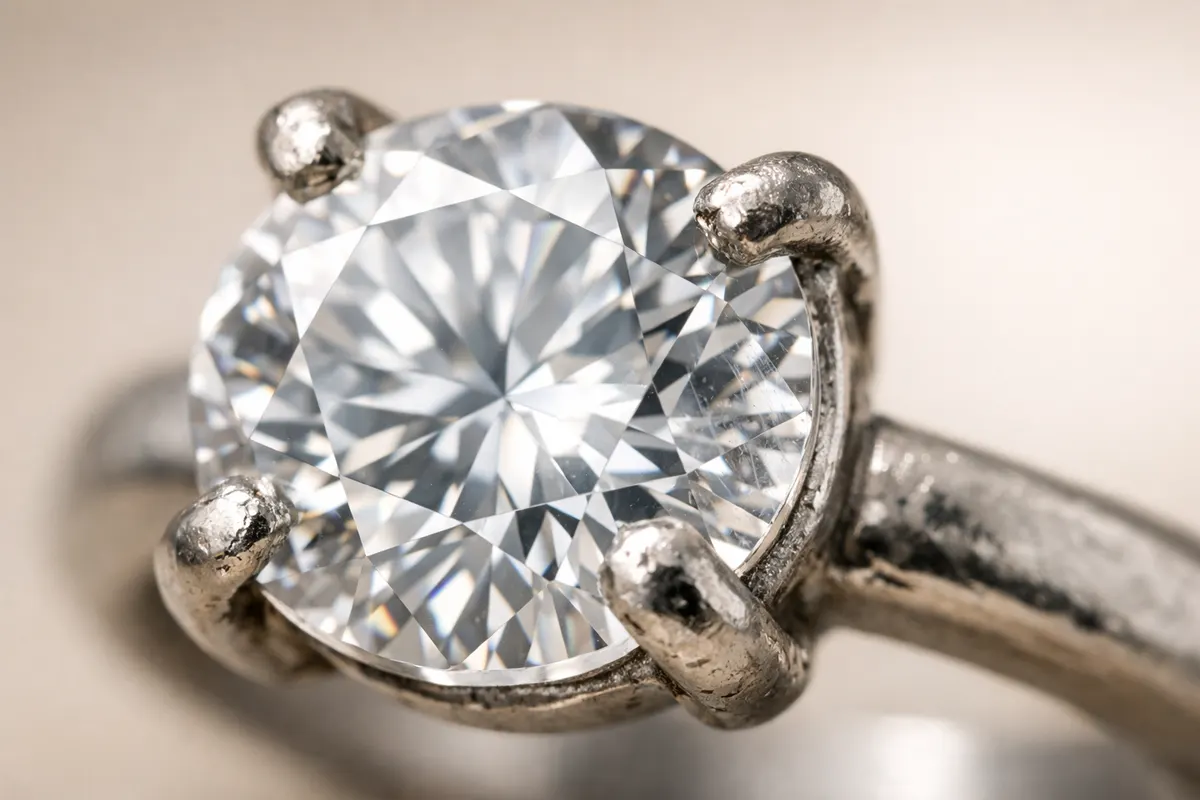
Cubic zirconia vs diamond is most usefully framed as “photo clues” versus “proof.” In photos, cubic zirconia (CZ) often looks overly fiery, perfectly clean, and slightly different in how it reflects light. Diamonds usually show a mix of white brilliance and subtler color flashes, plus tiny surface wear or natural inclusions when shown close-up.
A picture can suggest that a stone is likely CZ—for example, extremely colorful flashes in every light or a low-quality setting—but a photo alone cannot prove a diamond. Visual cues are screening tools that tell you whether you should accept the seller’s claim or pursue professional testing.
If you need a practical takeaway right now: treat photographic clues as triage. Use them to prioritize follow-up: request clearer images and documentation, ask for a trained appraiser’s test, or run inexpensive at-home screens (fog test, loupe check) before spending on formal lab verification.
- Photos can raise suspicion but not confirm identity.
- CZ often shows stronger colorful 'fire' and near-perfect clarity.
- Diamonds often pair with higher-quality settings and may show tiny inclusions.
- Use photos to decide whether to test further, not to buy or appraise for value.
Side-by-side: cubic zirconia vs diamond clues
This table summarizes the most useful visual clues you can reasonably get from a photo, how confident you can be from images alone, and the best next step. Remember that lighting, camera quality, and post-processing can change these signals.
After the table are practical notes about interpreting each row: why the clue matters and realistic limits of photo-based reads.
| Visible clue | Typical CZ | Typical diamond | Photo confidence | Recommended next step |
|---|---|---|---|---|
| Colored 'fire' (rainbow flashes) | Often vivid, frequent colorful flashes | Usually subtler, balanced white brilliance | Moderate — camera can exaggerate | Request close-up in point-light and diffuse light |
| Clarity and inclusions | Frequently spotless (lab-grown) | Often shows small natural inclusions at 10x | High for obvious inclusions; low for subtle ones | Ask for a 10x loupe photo or loupe inspection |
| Facet edges and crispness | Very sharp, sometimes slightly rounded with wear | Crisp but may show tiny nicks from wear | Moderate — macro helps | Get macro detail of facet junctions and pavilion |
| Setting quality | Common in plated or low-grade settings; glue or thin prongs | Usually set in solid precious metal with hallmarks | High — metals and marks are visible in photos | Photograph hallmarks and prong bases; check metal quality |
| Weight/size mismatch (heft clues) | Denser — same mm appears heavier in hand (not in photo) | Lighter than CZ at same size | Low — photos can't show weight | Request carat weight, dimensions, or a scale photo |
| Fog test behavior (thermal) | Holds fog longer (slower thermal dissipation) | Clears almost instantly | Low — requires live test | Run a fog test or use a thermal diamond tester |
- Interpret the table as a screening guide — use it to decide what verification to request.
- If a row points strongly toward CZ, combine that clue with setting and provenance before acting.
- If evidence conflicts (for example, strong fire but fine setting), prioritize physical testing.
When a photo clue points to CZ or diamond
Photos are most helpful when you need to triage: decide whether to walk away, request more proof, or pay for testing. Use CZ photo clues when multiple indicators align: exaggerated fire, perfect clarity, and a cheap or plated setting. Those together raise the odds that the stone is a lookalike rather than a natural diamond.
Conversely, treat a photo as leaning toward diamond when you see balanced white brilliance rather than constant rainbow flashes, natural-looking inclusions, and a sturdy precious-metal setting with visible hallmarks. Even then, the photo is suggestive—not definitive.
Different situations change how you act on clues. If you’re considering a low-cost purchase for casual wear, photo evidence and a seller return policy may be enough. If you’re buying a higher-value item or selling, always plan physical verification with a reputable appraiser or lab before finalizing the price.
- Buy for casual use (low risk): photos + seller return policy may be acceptable.
- Buy for investment or resale (high risk): require lab certificate (GIA/IGI) or documented tests.
- Selling: disclose photographic clues and offer independent testing to reassure buyers.
- Gift or repair decisions: check setting and prongs in photos; request closer shots if metal quality is unclear.
Why cubic zirconia and diamonds get confused
Several lookalikes—including CZ and moissanite—are designed to imitate diamond’s visual language: clear bodycolor, brilliant facet pattern, and classic cuts. From a distance or in low-resolution photos, they can appear identical. The confusion often starts with lighting: phone cameras and overexposure can wash out a diamond’s subtle white sparkle and emphasize colorful flashes that make it resemble CZ.
Manufacturing and finishing also blur lines. CZ is typically lab-created with very consistent cutting and clarity, producing predictable reflections. Diamonds, especially smaller melee or lower-clarity stones, may be faceted to similar proportions and look similar in retail photos. Sellers sometimes use bright point lighting in images to increase fire—this benefits CZ and moissanite visually and can mislead buyers.
Finally, human perception plays a role. Shoppers expect diamond-like sparkle in jewelry photography and may mentally label anything very sparkly as a diamond. That creates a bias that photo evidence then reinforces, producing false confidence without testing.
- Camera optics and high-contrast lighting can create artificial 'fire' in any gemstone photo.
- CZ and moissanite are often flawless in images, while diamonds can be edited to hide flaws.
- Cheaper settings paired with ultra-clean stones are a red flag—perfect clarity + low-quality metal often points to CZ.
Verification path for cubic zirconia vs diamond
If a photo raises doubt, follow a verification path that moves from non-destructive screening to definitive testing. Start with improved documentation: ask the seller for multiple, unedited photos taken in different lighting (diffuse daylight and a focused point light), include a macro shot of facet junctions, photos of hallmarks on the band, and a clear image of the setting from the side.
Next, run safe at-home checks before paying for pro services. Use a 10x loupe to look for needle-like or pinpoint inclusions (common in diamonds) and for gas bubbles or perfectly rounded inclusions (more common in CZ). Try the fog test: breathe on the stone and time how quickly the fog clears; fog that dissipates almost instantly is consistent with diamond’s higher thermal conductivity. Avoid scratch tests and aggressive handling—those can damage the stone or the setting.
If you still need certainty, escalate to recommended professional tools: a trained jeweler’s loupe or microscope inspection, a calibrated thermal conductivity tester (note: thermal testers can mistake moissanite for diamond), and, for absolute authentication and grading, a gemological lab report (GIA, IGI, or similar). If you want targeted reading, our guides on Cubic Zirconia: Identification, Value, and Real Examples (https://jewelry-identifier.app/wiki/cubic-zirconia) and Diamond Identification — What to Look For, With Real Examples (https://jewelry-identifier.app/identify/diamond-identification) explain those steps with illustrations.
- Document: get multiple unedited photos (diffuse + point light), hallmarks, and side views.
- Screen: loupe inspection and fog test are low-cost, non-destructive screens.
- Professional: use a thermal tester or bring the piece to a trusted jeweler.
- Definitive: request a lab report from a recognized gem lab for high-value items.
Related guides
Document visible clues with Jewelry Identifier before testing
Use the Jewelry Identifier app to record the photos and observations that matter: macro views of facets, clear images of hallmarks and prongs, and side profiles. Those documented clues make it easier to decide whether to request a lab report or take the piece to a jeweler. Jewelry Identifier helps you organize evidence so you can move from photo suspicion to a confident verification plan.
Take the next step →Frequently asked questions
Can I tell from a phone photo whether a stone is CZ or diamond?
A phone photo can suggest likely candidates through clues—excessive rainbow 'fire,' perfect clarity, and low-quality settings often point to CZ—but it cannot prove a stone is a diamond. Camera lighting, exposure, and compression can exaggerate or hide optical properties. Treat photos as a reason to request testing, not as final proof.
What simple at-home checks can help tell cubic zirconia vs diamond?
Non-destructive at-home checks include the fog test (diamond clears fog almost immediately), a loupe inspection at 10x to look for inclusions or gas bubbles, and evaluating the setting and hallmarks. Avoid scratch tests or anything that risks damaging the stone or setting. If results remain unclear, seek professional testing.
How reliable are diamond testers versus moissanite or CZ?
Thermal conductivity diamond testers are generally effective at distinguishing CZ from diamond, but moissanite can give false positives on some thermal testers because it also conducts heat well. More advanced testers or electrical conductivity testers are needed to separate moissanite. For high-value decisions, laboratory confirmation remains the gold standard.
Should I refuse a purchase if a seller won’t allow testing?
If a seller refuses any verification for a high-value item—no close photos, no independent appraisal, and no lab report—that’s a legitimate red flag. For lower-value or costume pieces, a seller’s constraints may be reasonable, but for investment-grade purchases always insist on independent verification before completing the transaction.