

Jewelry Identification
Edwardian Jewelry: Identification, Value, and Real Examples
Discover how to spot edwardian jewelry from photos, the hallmark and style clues to check, and realistic resale tiers for secondhand pieces.
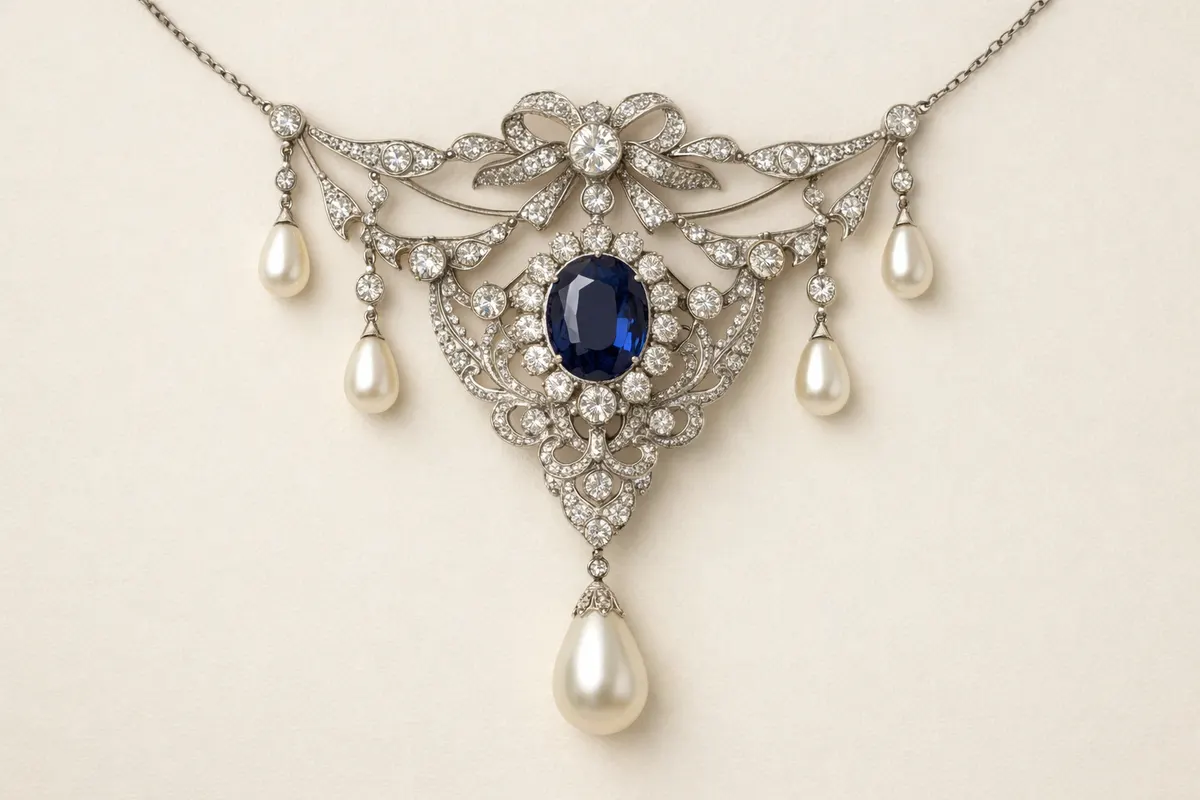
What Edwardian jewelry is and where it came from
Edwardian jewelry describes decorative personal pieces made in the early 20th century, roughly during King Edward VII’s reign (about 1901–1915). The term covers rings, brooches, necklaces, and earrings that share a distinctive aesthetic: airy, lace-like metalwork; fine milgrain edge detail; and a light, elegant silhouette intended to complement contemporary fashions.
Metals and construction typical of this era favor platinum and higher-karat gold combined with delicate handwork. Platinum was prized because its strength allowed very fine openwork and secure settings for small diamonds; gold—often 18K in continental pieces—was used where a warmer tone was desired. Settings commonly show filigree, pierced (open) backs, and close, low prongs that cradle stones without heavy bezels.
Gem choices reflect Edwardian taste: diamonds and seed pearls were dominant for evening wear, often paired with sapphires, aquamarines, or pastels. Jewelry from this period emphasizes sparkle created by many small stones rather than few large gems, and pieces are sized to sit lightly against the body rather than dominate it.
When evaluating an item, treat the label “Edwardian” as a style attribution unless backed by maker marks, provenance, or an assay record. Many later revival pieces copy Edwardian motifs; distinguishing original work requires attention to construction, wear, and marks rather than just design alone.
How can you tell if a piece is Edwardian?
Photographs can reveal many useful signs. Start with high-resolution close-ups of the top, underside, and hallmarks. In genuine Edwardian pieces you’re most likely to see delicate openwork and hand-filed edges, tiny millegrain dots around stone seats, and consistent hand engraving patterns rather than machine-etched repeats.
Check the way stones are set: Edwardian diamond work often uses many small rose-cut or old European–cut stones in shared or millegrain-set pavé. Look for low, narrow prongs or bead-set pavé that holds small stones closely together; excessively deep modern collet settings or thick machine-soldered pads suggest later manufacture.
Metal clues: platinum examples tend to be fine and lightweight for their size yet rigid in openwork; if the piece is unusually soft or shows thick plating worn through to a base metal, it’s likely a later reproduction or repaired item. Use a magnet photo test—if the visible clasp or chain reacts strongly to a magnet, it’s indicative of ferrous base metal and not an Edwardian platinum or high-karat gold construction (though magnetism alone isn’t definitive).
Hallmarks and maker marks: clear stamped marks on the inside of rings or on clasps help. Look for karat marks like 18K/750, abbreviated platinum marks (PLAT, PT) or country assay marks and maker initials; these add weight to an Edwardian attribution but do not prove it on their own. If you see modern laser stamps, stereolithography casting seams, or identical repeating engraving patterns, treat the piece as likely modern or heavily restored.
- Visible millegrain and hand-engraving indicate period handwork.
- Openwork filigree and lace-like settings favor Edwardian-era construction.
- Many small old-cut or rose-cut diamonds set tightly together are typical.
- Magnetism or heavy base-metal exposure at worn areas suggests plated or later pieces.
- Clear assay/maker marks strengthen an attribution but don’t guarantee age.
Edwardian jewelry: key facts at a glance
Below are concise technical attributes to use as a photo-checklist. These rows focus on what you can reasonably confirm from images and a few simple handheld checks.
| Attribute | Typical Edwardian Example | What to inspect in photos |
|---|---|---|
| Composition | Platinum frames; 18K–14K gold accents | Look for platinum stamps (PLAT/PLATINUM) or high-karat gold marks inside rings or on clasps |
| Gem types | Small old-cut/rose-cut diamonds, seed pearls, sapphires | Check for many small stones in pavé/cluster arrangements, and natural pearl surface texture |
| Construction | Hand-filigree, pierced backs, fine millegrain | Zoom on edges for tool marks, asymmetry from handwork, and openwork finishing |
| Common marks | Maker initials, assay office marks, karat or platinum abbreviations | Photograph inside bands and clasp areas at high magnification for tiny stamped marks |
| Care sensitivity | Delicate solder joins and soft settings | Look for hairline repairs, missing millegrain, or loose tiny stones near junctions |
What Edwardian jewelry is worth on the secondhand market
Resale prices for Edwardian jewelry vary widely depending on condition, materials, gemstone quality, and provenance. Use secondhand-market framing: auction lots, estate dealers, and specialist vintage retailers will price pieces differently. The ranges below are for typical market experiences and should not be used as a formal appraisal.
Key value drivers are metal (platinum or high-karat gold increases baseline value), the cumulative carat and quality of diamonds, presence of original maker marks or documented provenance, and overall condition (intact millegrain, original stones, and unaltered settings add value). Heavy restoration, non-original stones, or missing details reduce market interest and price.
Small, high-quality documented pieces by known makers or with strong provenance can reach collector-level prices; most modest examples sell in conservative resale tiers.
| Tier | Typical resale range (USD) | What typically drives this price |
|---|---|---|
| Entry | $75–$400 | Base metal or thinly plated pieces, heavy wear, or lots of missing detail |
| Mid | $400–$1,800 | Platinum or 18K pieces with many small diamonds or pearls in good condition |
| High | $1,800–$10,000 | Well-preserved platinum examples, notable maker stamps, larger cumulative diamond weight |
| Exceptional | Above $10,000 | Museum-quality provenance, famous maker, or rare materials and documented provenance |
- Provenance and maker stamps can move a piece from mid-tier into high or exceptional tiers.
- Loose or replaced stones, extensive repairs, and heavy plating diminish resale value.
- Photos that show intact original finishes and consistent wear patterns perform better in online listings.
What Edwardian jewelry is commonly mistaken for
Edwardian pieces are frequently confused with late Victorian (Aesthetic) and Art Nouveau items because these periods overlap stylistically. Late Victorian jewelry can share delicate detail but tends to be heavier in silhouette and more varied in metal mixes; Art Nouveau favors flowing, organic lines with asymmetrical motifs and often uses larger, singular stones or enamel.
Reproductions and Edwardian revival jewelry from mid-20th-century makers mimic period motifs but differ in construction: modern revival pieces often show machine-symmetric engraving, modern soldering techniques, and contemporary hallmarks or laser stamps. Photos revealing perfectly repeated engraving patterns, very bright modern finishes, or modern manufacturer stamps are clues the piece is not original.
Art Deco is another frequent confusion because it immediately follows the Edwardian era and sometimes incorporates older stock stones in newer geometric settings. Art Deco jewelry typically has stronger geometric lines, stepped motifs, and larger, more angular stone cuts (e.g., emerald-cut diamonds) instead of the small, round-old cuts favored in Edwardian pavé work.
- Late Victorian vs Edwardian: Victorian tends toward denser forms and more varied gem mixes; check overall silhouette.
- Art Nouveau vs Edwardian: organic, flowing enamel work and asymmetry point to Art Nouveau.
- Reproductions: machine-made symmetry, modern stamps, or unusual plating wear patterns suggest later manufacture.
Caring for Edwardian jewelry
Treat Edwardian pieces gently. The fine filigree and millegrain settings are more vulnerable to knocks and abrasion than modern mass-produced jewelry. Store items separately in soft pouches to prevent small stones from rubbing against harder gems or metal.
Cleaning should be conservative: avoid ultrasonic cleaners on heavily fractured or repaired pieces and on some pearls. A soft brush, mild soap, and warm water for a short period is safer for most Edwardian pieces; pearls and porous stones should never be soaked. When in doubt, photograph condition before any cleaning or repair so you retain a visual record.
For significant repairs—re-tipping prongs, replacing missing stones, or re-soldering openwork—consult a jeweler experienced with vintage construction. Inexperienced soldering or heavy reshaping can destroy period joins and dramatically reduce historical and resale value.
- Avoid ultrasonic cleaning for repaired or fragile items; prefer gentle hand cleaning.
- Keep pearls away from acids, perfumes, and long water exposure.
- Document condition with photos before any conservation work.
Frequently asked questions
What years define the Edwardian jewelry period?
Edwardian jewelry is broadly associated with the reign of King Edward VII, roughly 1901–1915. The term captures an aesthetic that peaked in those years, though some pieces labeled Edwardian were made slightly before or after that window and similar motifs were reproduced later.
Can a photo prove a piece is authentic Edwardian?
A photo can provide strong clues—construction details, hallmarks, gemstone cuts, and wear patterns—but it cannot conclusively prove authenticity alone. Definitive attribution often requires physical inspection, hallmark verification under magnification, tests on metal and stones, and provenance documentation.
Are pearls common in Edwardian jewelry, and how can you tell if they’re original?
Yes—seed pearls and small natural pearls are very common in Edwardian pieces, used to soften and shade designs. In photos, look for matching surface texture, slightly irregular shapes, and consistent setting age (millegrain or old prongs). Uniformly perfect, identical pearls may indicate later replacement or stringing.
Should I get a repair or restoration for an Edwardian piece I found?
Prioritize conservation over heavy restoration. Simple repairs that stabilize loose settings are usually beneficial; aggressive re-polishing, re-plating, or reshaping can remove original finishes and reduce historical value. Photograph the piece, request a conservative estimate from a vintage-aware jeweler, and keep original components whenever possible.
Related guides
Compare your photos against these Edwardian clues
After you check the visible clues above—hallmarks, millegrain, openwork, and stone cuts—use Jewelry Identifier as a first-pass comparison tool to see how your piece matches Edwardian features. The app can help highlight hallmark areas and suggest close stylistic matches; follow that with a hallmark reading or in-person inspection for confirmation. Start the first-pass comparison at https://jewelry-identifier.app/tools/jewelry-identifier and then consider a specialist opinion if the piece appears high value or has maker marks.
Take the next step →