

Jewelry Identification
Mourning Jewelry: How to Identify, Value, and Spot Lookalikes
Learn which visible clues in a photo point to mourning jewelry, what drives secondhand value, and the checks worth doing before trusting a single image.
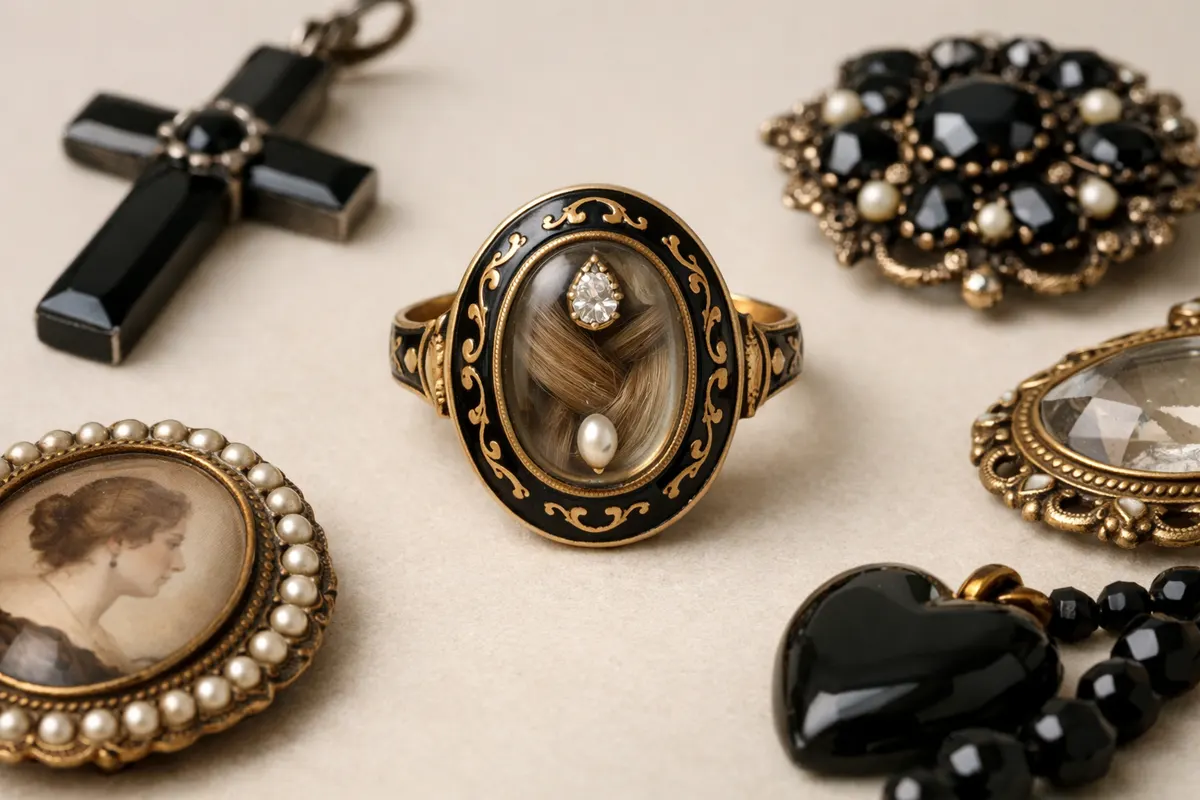
What mourning jewelry is and where it came from
Mourning jewelry refers to personal ornaments deliberately made to remember a deceased person. Most commonly associated with the 18th and 19th centuries — especially Victorian Britain and North America — it includes lockets, rings, brooches and bracelets that incorporate black materials, funerary motifs (urns, willows, skulls), dated inscriptions, or a small compartment to hold hair or a relic.
Two broad types appear in collections: symbolic mourning pieces, which use imagery or black finishes to express grief, and hairwork jewelry, which contains braided or woven hair from the deceased. Materials vary by date and price: inexpensive mid-20th-century costume pieces used black glass or enamel, while genuine Victorian mourning often used jet (fossilized wood), vulcanite/gutta-percha, or blackened gold with enamel.
Identifying mourning jewelry is both a style and construction exercise. The same motifs were reused across decades, and some modern makers copy Victorian forms. Context — inscriptions, maker marks, clasp styles and the presence of hairwork — helps place a piece, but a clear photographic record only shows some of those signals; provenance and hands-on inspection remain essential for higher-confidence attribution.
- Common forms: lockets with hair compartments, mourning rings engraved with dates, jet brooches, black enamel crosses.
- Typical motifs: urns, willows, hands clasped, skulls, mourning phrases like “In Loving Memory.”
- Materials by era: early/mid-19th c. often jet or hairwork; late 19th–early 20th c. include gutta-percha, black enamel, or blackened gold.
How can you tell a piece is mourning jewelry from photos?
A photo can prove some clues and only suggest others. Strong photo-evidence includes clear inscriptions (names, dates, ‘In Memory of’), visible hair compartments or woven hair, characteristic mourning motifs, and consistent wear on black materials that indicates age rather than recent finishing.
Look closely at construction details in macro photos: a small compartment with remnants of braided hair, a glazed inset over hair, or a hinged locket whose interior shows a paper card or lock of hair are compelling photo signals. Equally important are clasp and hinge types: Victorian C-clasps, long safety pins, or hand-made hinges suggest older pieces.
Other indicators are maker’s marks and assay stamps found inside lockets or on ring shoulders. High-resolution images of these marks can narrow origin and metal content, but a visible stamp alone does not confirm that hair or jet is original to the piece.
- Search for inscriptions and dates in clear-lit photos — these are the easiest photo-verifiable evidence.
- Macro shots of locket interiors: braided hair, paper name cards, or glued hairwork are strong clues.
- Inspect edges and exposed areas for material cues: jet often wears to brown at edge chips; enamel shows distinct flaking; molded plastics reveal seam lines.
- Photograph any hallmarks or maker marks on the inside surfaces; share magnified images with specialists if you need further help.
Key facts and identification attributes
The table below summarizes the most useful attributes to note when assessing mourning jewelry from photos. Each row combines what the attribute typically is, how hard or soft that material or feature is, and the most useful photo clues you can capture to support an identification.
When photographing for identification, include macro shots of hallmarks and the locket interior, edge close-ups to show material wear, and one full-frame shot to capture style and proportion.
| Attribute | Typical | Photo-checkable clues |
|---|---|---|
| Composition | Jet, gutta-percha/vulcanite, black enamel, gold, glass | Edge chips (brown core on jet), seams on molded plastic, enamel flaking |
| Hardness / durability | Jet: medium; enamel: hard but flakes; gutta-percha: softer | Scratches, polish wear, brittle chips visible on high-res images |
| Common marks | Gold karat marks (9kt, 18k), maker’s stamps, inscriptions | Legible hallmarks inside locket or on ring shoulders |
| Typical settings | Lockets with compartments, mourning rings, brooches with closed backs | Interior compartments, glazed hair windows, engraved dates |
| Care sensitivity | Hairwork and gutta-percha are moisture- and heat-sensitive | Signs of adhesive residue, warped interiors, discolored hair strands |
- Photograph against neutral background with diffuse light to avoid reflections on black surfaces.
- Include a ruler or coin for scale in at least one photo.
- Take both exterior and interior views of lockets and brooch backs.
What mourning jewelry typically sells for on the secondhand market
Resale value for mourning jewelry is driven by material, maker, condition, rarity of motif, and whether the piece contains original hairwork or verifiable provenance. Prices shown here are secondhand-market ranges intended as orientation only; they are not appraisals and can vary by region and demand.
Condition issues that commonly reduce value include missing hairwork, cracked enamel, poorly repaired hinges, heavy polishing that removed hallmarks, or loss of original components. Conversely, legible inscriptions, intact hairwork, documented provenance, and identifiable maker’s marks can raise interest and price.
| Tier | Typical resale range (USD) | Primary value drivers |
|---|---|---|
| Estate costume / recent reproductions | $10–$75 | Molded glass, modern blackened metal, non-original hairwork |
| Period but common examples | $75–$600 | Gutta-percha or black enamel lockets, modest gold lockets with wear |
| Higher-quality period pieces | $600–$3,000 | Jet, intact Victorian hairwork lockets, identifiable makers |
| Exceptional / museum-quality | $3,000+ | Documented provenance, signed makers, rare motifs or large ensembles |
- Market demand for mourning pieces has grown among collectors of Victorian jewelry and historical costume, which can lift prices for well-documented examples.
- Unsigned, common black-on-gold costume pieces often trade for modest sums even if they look old.
- Provenance and documentation matter: a named owner or linked date can shift a piece up a value tier.
What mourning jewelry is often mistaken for
Several common materials and modern reproductions mimic mourning pieces, so photos can mislead. Distinguishing features tend to be surface texture, how the material chips or wears, and construction evidence visible in close-ups.
Below are the most frequent lookalikes and the photo clues that help tell them apart. When in doubt, magnified images of edges, reverse sides and any hallmarks usually resolve the question or at least narrow the possibilities.
- Black glass / paste vs. jet — glass is uniformly shiny and can show mold lines or bubbles; jet has a warmer, slightly resinous surface and may show brown where chipped.
- Bakelite or molded plastics vs. gutta-percha/vulcanite — plastics often show seam lines and uniform color; older gutta-percha can look duller and be brittle at thinner edges.
- Modern blackened (oxidized) metal vs. historic black enamel — oxidation often flakes or rubs off in thin areas, while true enamel chips to reveal a bright metal beneath.
- Reproduction hairwork vs. original hair — modern machine-trimmed hair and perfectly uniform braids can indicate a later replacement; genuine Victorian hairwork usually shows slight irregularities and aged patina on the adhesives.
Care and handling for mourning pieces
Handle mourning jewelry gently. Hairwork and materials like gutta-percha and jet are sensitive to moisture, heat and solvents. Avoid soaking lockets and never use ultrasonic cleaners on pieces that may contain hair or delicate enamels.
For routine cleaning, use a soft, dry microfiber cloth for black surfaces and a slightly damp cloth for non-porous metal areas; immediately dry the piece. If a locket appears to contain historical hair, keep it dry and avoid opening it frequently, since exposure to humid air accelerates deterioration.
If a piece is visibly fragile, cracked, or bonded with old adhesives, consult a professional conservator or a jeweler experienced in antique work before attempting repairs. Document condition with detailed photos before any conservation to preserve provenance evidence.
- Do not submerge hairwork or gutta-percha in water; moisture can swell and dislodge hair.
- Avoid chemical cleaners and strong solvents that can remove original finishes or damage adhesives.
- Store flat, in a dry, dark place with stable temperature and silica gel packets to control humidity.
Frequently asked questions
How old is mourning jewelry and when was it most popular?
Mourning jewelry became especially common in the late 18th and 19th centuries, with a major peak during the Victorian era (roughly 1837–1901). While earlier and later examples exist, the period saw standardized motifs (urns, willows, skulls) and the practice of incorporating hair became widespread. Later 20th-century pieces sometimes imitate Victorian styles but use different materials such as glass or modern blackened metals.
Can you tell if a locket contains original hair from a photo?
A photo can show the presence of hair and some clues about authenticity — for example, tightly woven, aged-looking strands, discoloration consistent with age, and period adhesives — but it cannot prove that the hair is original or from a specific person. High-resolution interior shots that show how the hair is mounted, along with inscriptions or provenance, increase confidence but do not replace hands-on testing or documentation.
Is mourning jewelry worth a lot of money?
Some mourning pieces have modest resale value, while others can command high prices depending on material, maker, condition and provenance. Common costume-style items often sell for under $100, typical period lockets and rings can range from a few hundred to a few thousand dollars, and rare documented examples may fetch more. These are secondhand-market patterns rather than fixed appraisals; condition and documentation have large effects on price.
How should I photograph a piece to check if it's mourning jewelry?
Take multiple clear photos: one full-frame shot to show overall style, close-ups of the interior and any compartments, macro shots of hallmarks or inscriptions, and edge photos to reveal material wear. Use diffuse natural light or a lightbox to minimize reflections on black surfaces, include a coin or ruler for scale, and capture the back and any hinges or clasps. These images are the most useful for initial visual identification.
Related guides
Compare your photo against these Mourning Jewelry clues
After you've captured clear close-ups of hallmarks, the locket interior and any hairwork, use Jewelry Identifier as an optional next step to compare your images against the visual clues on this page. The tool can help surface matching features and suggest likely materials, but it does not replace hands-on appraisal or provenance research. Learn more and try a guided photo comparison at https://jewelry-identifier.app/tools/jewelry-identifier.
Take the next step →