Jewelry Marks Identification: Compare Apps and Expert Checks
Learn which jewelry marks identification clues a photo can show, which require follow-up, and when to consult a qualified specialist for confirmation.
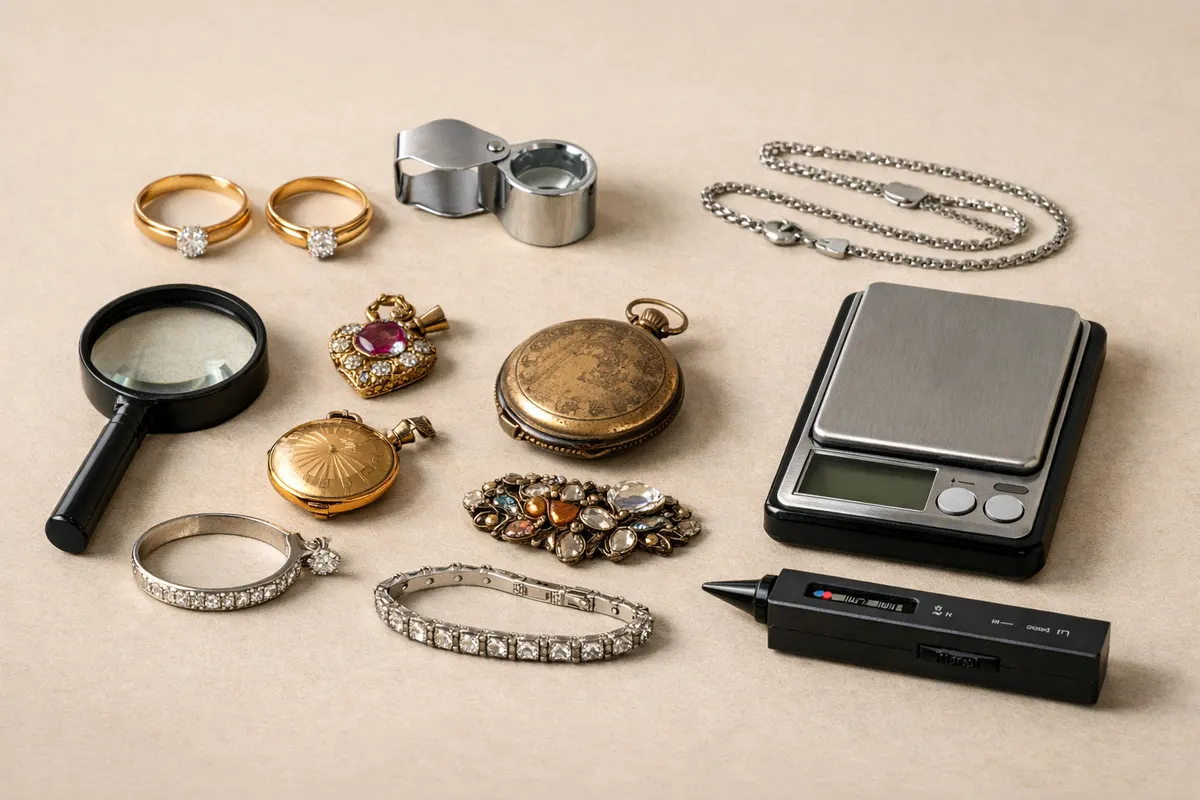
Who needs jewelry marks identification and why
If you’ve found a ring, brooch, or pendant with a faint stamp and you want to know where it came from, you need practical jewelry marks identification. This situation is common for estate buyers, family members inheriting pieces, vintage sellers prepping listings, and anyone who wants to check material or maker clues before paying for a professional appraisal.
A single photo can often answer straightforward questions—whether a visible stamp reads a common karat mark or an obvious maker's initial—but many real-world marks are partial, worn, or made with lookalike punches. That’s why this comparison guide treats a photo app as a first-pass research tool, not proof. It helps you triage: which items you can research further yourself and which deserve expert verification.
Think in terms of evidence quality. A legible number, a distinctive outline, or a complete group of marks gives you something to compare with a documented reference. Worn impressions, solder-covered stamps, or marks on replaced components leave more uncertainty. Record what you can actually see before trying to name a maker. A reading of the stamp is a separate question from whether the stamp is genuine.
When the stakes are monetary, sentimental, or legal, err on the side of verification. Use the visible clues you can document in photos to narrow possibilities, then pick the next step based on how much uncertainty remains and how important a definitive answer is to you.
- Good fit: estate buyers, heirs, secondhand sellers, hobbyist researchers.
- First-pass aim: get a short list of plausible makers or metal types from photos.
- When to escalate: worn stamps, plated surfaces, repairs that hide marks, or high-value items with uncertain provenance.
- Evidence to gather before any app or expert: clear macro photos, measurements, notes on construction, and any paperwork.
Jewelry marks identification guide: choose a research method
Choose the method that answers your current question. A photo tool can suggest visible jewelry categories and material or style clues. A documented reference helps you compare the exact letters, symbol outlines, and arrangement of a legible mark. A qualified specialist can inspect the physical piece and recommend appropriate testing. Moving between these methods is usually more useful than repeatedly scanning the same unclear photograph.
For a first-pass app check, use a focused photograph of the piece and a separate close-up of the mark when needed. Read the output as a suggestion to investigate. Do not treat fluent wording, a convincing maker name, or a numerical score as proof. Check the actual product description before expecting a built-in mark database, side-by-side reference images, or a human review service; those features are not interchangeable with image analysis.
For reference research, copy the visible characters exactly, including spaces, punctuation, and uncertain letters. Compare the whole group of marks and the shape around each symbol. A match to one initial is weaker than agreement across several independent details. Our Jewelry Hallmarks & Maker's Marks wiki introduces the terminology; an assay office's own reference material is the next place to check a claimed official hallmark. Our editorial wiki is not an authentication certificate.
For hands-on review, first define the question: metal composition, maker attribution, gemstone identity, or an appraisal for a stated purpose. These can require different expertise. A composition test does not by itself establish who made the piece. Ask the specialist which methods address your question and what uncertainty will remain, especially when repairs, plating, or replacement components complicate the result.
- Photo app: collect tentative visual clues and decide what to examine next.
- Documented reference: compare a legible mark with an attributable source.
- Specialist inspection: investigate the physical item and choose suitable tests.
- Keep the original photos and write down which letters remain uncertain.
- Separate a plausible stamp reading from authenticated origin or metal content.
Free vs paid expectations for mark identification tools
Compare free and paid tools by their stated capabilities, limits, and terms rather than assuming a paid tier authenticates jewelry. Some services charge for extra scans or storage; others offer access to references or a separate expert consultation. Check the current listing for the specific service before paying. This guide does not claim that Jewelry Identifier includes a curated maker-mark database or human authentication service.
A free visual check can be useful when you need an initial description of an unfamiliar item. It may be less useful when your only question is whether a worn character is an R or a B. In that case, better photographs and a documented reference comparison may help more than another scan. Keep the whole-piece image as well as the close-up so you can compare the proposed reading with the surrounding construction.
A subscription cannot recover detail that the photo never captured. Stabilize both the phone and the piece, use diffuse light, and try several angles without polishing away the surface. A loupe or a phone's macro mode can help you inspect small features. Avoid sharpening or enhancement that invents edges: keep the original image alongside any edited copy, and mark unreadable characters as uncertain rather than filling them in from an expected match.
Professional examination is a separate service with a separate scope. Sheffield Assay Office describes X-ray fluorescence (XRF) as a method used in precious-metal analysis. GIA's Gold-Plated Gold case study also shows why plating and test interpretation matter. Let a qualified specialist select and interpret a suitable method; neither an app reading nor a magnet check proves purity. Do not scratch or acid-test a potentially valuable piece yourself simply to confirm a photo suggestion.
- Check what the current free allowance or paid tier actually includes.
- Ask whether any advertised human review covers identification, authentication, or valuation.
- Improve the original photos before buying more scans of the same unclear mark.
- Treat testing and formal appraisal as separate services with defined questions.
- For plating complications, see GIA's Gold-Plated Gold case study: https://www.gia.edu/gems-gemology/summer-2025-lab-notes-gold-plated-gold0
Why use Jewelry Identifier as the first-pass check
Jewelry Identifier offers a first-pass photo analysis of visible jewelry details. Its jewelry tool describes category, material and gemstone clues, style signals, condition notes, and practical next checks. That makes it a starting point for organizing observations about an unfamiliar piece. It does not establish that a maker's stamp is genuine, identify metal composition by measurement, or certify a piece's origin or value.
Prepare a clear image on a plain background and keep your own close-up of any readable mark. Compare the analysis with what is visible in the original photograph. If the output suggests a maker or material that the image does not support, leave that suggestion unconfirmed. This workflow does not rely on automatic mark cropping, punch-shape overlays, linked database matches, or exportable authentication reports.
For a practical example, imagine an inherited pendant with two partly worn initials and an unclear number. Use the photo check to organize visible construction and condition clues, then write the uncertain characters down yourself. Compare the full mark with documented examples. If several readings remain possible, retain those alternatives and bring the original photographs and piece to a suitable specialist instead of presenting the app's preferred reading as a fact.
The Jewelry Hallmarks & Maker's Marks wiki can help with terminology, while the What Does 925 Mean on Jewelry? guide covers a common silver stamp. Use those pages as background for your comparison, not as proof about the object in front of you. When resale, insurance, or an important attribution depends on the answer, ask a qualified professional what evidence and written documentation are appropriate for that purpose.
- Use the tool for a tentative description of visible jewelry details.
- Retain original photos and your own notes about uncertain marks.
- Compare a proposed reading with documented references independently.
- Request professional verification when the decision needs more than visual clues.
Related guides
Try Jewelry Identifier as your first-pass research tool
Use Jewelry Identifier for a first-pass description of visible jewelry clues. Keep your original photographs, compare any mark reading with documented references, and treat the result as a research lead. If authenticity or material content matters, take the piece and your notes to a qualified specialist. Start with the Jewelry Identifier tool at https://jewelry-identifier.app/tools/jewelry-identifier.


Frequently asked questions
When is a photo enough to identify a jewelry mark?
A clear photo can support a tentative reading of visible letters, numbers, or symbols. Compare the entire mark with a documented reference and keep ambiguous characters unresolved. Even a close visual match cannot prove that the stamp is genuine or establish metal content, provenance, or an item's alteration history. Use professional verification when authentication or an important transaction depends on the result.
How should I photograph tiny or worn marks for the best chance of a useful result?
Use a steady surface, strong diffuse light, and a macro lens or the phone’s macro mode if available. Place a coin or ruler for scale, tilt the piece slightly to catch shadow inside the impression, and take multiple angles: head-on, 15°–30° oblique to reveal depth, and with and without fill light to reduce glare. Also photograph surrounding construction—solder lines, jump rings, and clasp styles—because those contextual clues often separate plausible attributions from lookalikes.
How do I handle jewelry marks lookalikes when a photo is unclear?
If several marks look similar, compare the full group of characters, outlines, spacing, and surrounding construction. Take additional photographs under different lighting and retain more than one possible reading when necessary. A specialist may use physical examination, references, or suitable tests to investigate further. Metal analysis alone does not establish maker attribution, and some worn marks may remain unreadable.
What should I bring to a specialist when a photo leaves doubt?
Bring the item when practical, original whole-piece and close-up photographs, your transcription of the mark with uncertain letters flagged, and any receipts or provenance documents you already have. Explain whether you need a mark reading, material testing, maker attribution, or a valuation for a specified purpose. Ask about the examination's scope, limitations, and fees in advance; organized notes do not guarantee a lower fee or a definitive answer.