

Jewelry Identification
Georgian Jewelry: How to Identify, Care, and Estimate Value
Practical guidance on identifying Georgian jewelry from photos, what clues matter, and how specialists assess value and provenance before buying or selling.
What Georgian jewelry is and where it came from
Georgian jewelry refers to pieces made in the historical period conventionally dated 1714–1837, spanning the reigns of the Hanoverian Georges I–IV and William IV. The term groups a wide range of decorative techniques—paste (glass) stones, closed-back foiled gemstones, hand-engraved gold and silver, steel and silverwork, and sentimental motifs such as hairwork or mourning jewelry—rather than a single uniform material.
Most Georgian pieces were manufactured before industrialized, standardized production and often retain hand-finished joins, asymmetric cuts, and workshop-level finishing that differentiate them from later Victorian and Edwardian work. Construction choices—like closed-back foiled settings and riveted joins—reflect period practice and the available lapidary and setting techniques of the 18th and early 19th centuries.
When attribution is based on visible clues, treat claims as plausible attributions rather than proof. Hallmarking in Britain long predates the Georgian era: London's assay records begin around 1300, so the presence or absence of marks must be interpreted in that legal and historical context rather than taken alone as evidence of age. For a primer on hallmark history, see the Assay Office timeline (https://registration.assayofficelondon.co.uk/about-us/history-of-hallmarking).
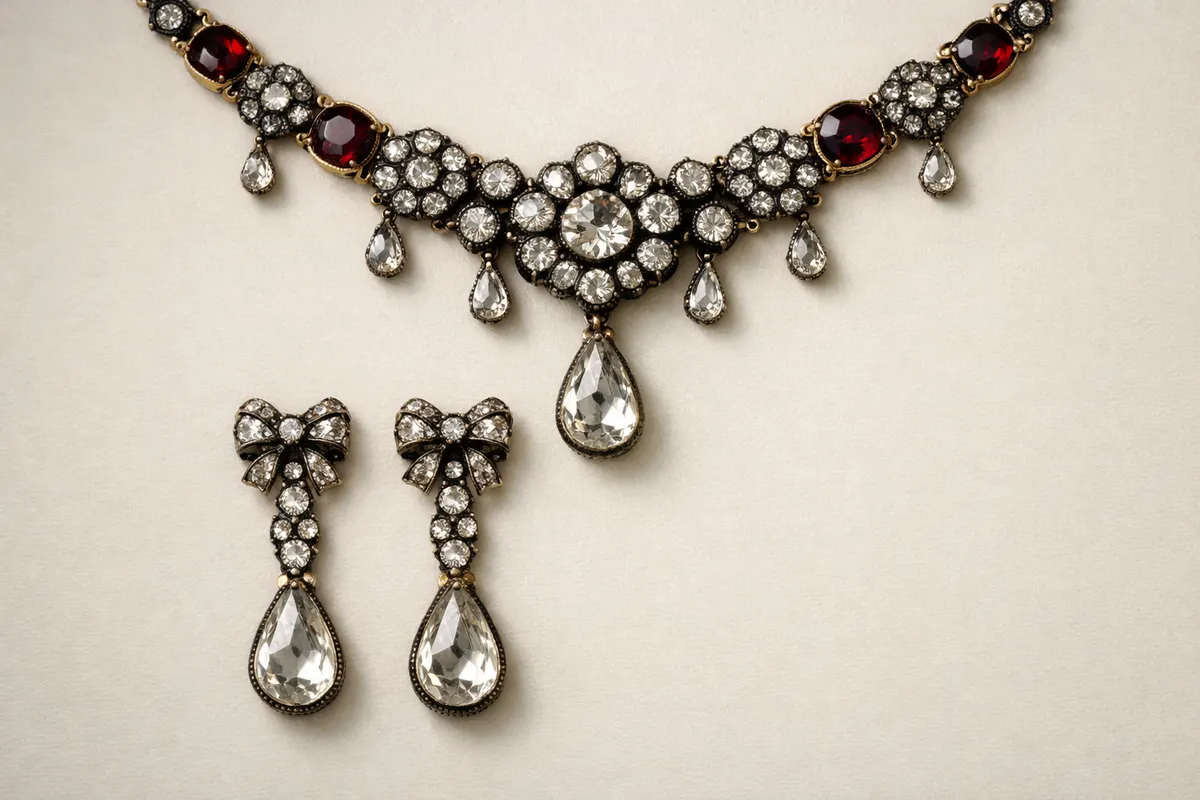
AI-generated period-inspired illustration; not an authenticated Georgian set or evidence of gemstone composition.
How can you tell a piece is Georgian jewelry?
Photos can show a number of reliable, photo-checkable signals that point toward a Georgian attribution, but no single visible trait proves age or origin. Look first at construction: hand-sawn settings, solder joins with uneven filing, pin-and-rivet closures, and foil-backed or closed-back settings for gemstones are common Georgian-era workshop traits.
Stone cuts and mountings offer clues, but old cuts and closed-back settings are also found in later reproductions and altered pieces. Examine facet patterns, the back of each setting, and any visible foil. Fragile stones, foil, and old joins may be easily damaged; avoid liquid cleaning of closed-back or foil-backed settings.
Marks and inscriptions are useful when present. Look for assay marks, maker’s marks, duty marks, or town marks on the inner surfaces of rings and clasps. Because British hallmarking goes back centuries, a readable assay mark with a reliable date letter can be strong evidence, but missing marks do not prove a piece is modern—workshop practice, repair, or removal can obscure marks.
Wear and tool marks can suggest how a piece was made and used, but neither proves its date. Handwork can occur in later reproductions, and older jewelry may contain replacement fittings or repairs. Clear close-ups of the front, back, joins, clasps, and marks allow a specialist to assess which components are consistent and which need closer inspection.
- Check joins and filing marks as construction clues; handwork alone does not establish age.
- Inspect stone backs: closed-back foiled settings often mean Georgian or early 19th-century technique; treat as fragile.
- Search for assay/maker marks on inner bands, clasps, and suspension rings; interpret within hallmark history.
- Compare cut geometry with documented examples; an old-style cut alone does not date the mounting.
Georgian jewelry at-a-glance: key facts
The table below summarizes core attributes to check in photos. Use these rows as a quick-reference checklist for visible signals and care sensitivities that commonly apply to Georgian-era pieces.
Remember that these are typical characteristics; individual pieces may vary because of region, workshop practice, later repair, or deliberate historicizing remakes.
| Attribute | Typical Georgian characteristic |
|---|---|
| Composition | Gold, silver, copper alloys, paste glass, and natural gemstones; materials vary by piece |
| Hardness / durability | Durability varies; paste, foils, and aging joins may be fragile |
| Common marks | Assay and date letters (when present), maker’s punch; absence of mark does not equal modern |
| Typical settings | Closed-back foiled settings, collet mounts, riveted brooch backs, and hand-formed bezels |
| Care sensitivity | Closed-back/foiled stones and fragile riveted joins require dry, non-liquid handling and specialist inspection |
How collectors and buyers value Georgian jewelry
Estimate resale value from completed sales of genuinely comparable pieces: similar materials, period attribution, condition, and documented provenance. Museum catalogues help compare construction and style, but they are not sale-price records. Auction results also need context, including whether the quoted amount includes a buyer’s premium.
Factors that most strongly affect market value are material (solid gold, silver, or high-value gemstones), documented provenance or notable maker, technical rarity (e.g., unusual enameling or rare motifs), and condition—especially intact original foils, stones, and unaltered mountings. Repaired, heavily altered, or structurally weakened items typically trade lower and may require specialist conservation before sale.
The table describes factors that affect a sale rather than providing unsupported price bands. Select comparable realized auction results, record the sale date and condition, and explain any important differences. A specialist may need to inspect the settings and repairs before assigning a value.
| Tier | Market context | What most affects outcome |
|---|---|---|
| Everyday resale | Local dealers, estate sales, online marketplaces | Wear, non-descript maker, altered settings |
| Collector interest | Specialist dealers and niche auctions | Attractive motifs, rarer techniques, good condition |
| High-provenance | Documented sales at specialist auctions | Documented provenance, named maker, exceptional condition |
| Condition-sensitive lots | Specialist inspection before treatment or sale decisions | Fragile closed-back foils or unstable joins that limit channels |
- Value depends on comparable sales and provenance, not age alone.
- Condition and original settings (especially closed-back foils) materially change both value and conservation needs.
- Documented hallmarks or a confirmed maker increase buyer confidence and can broaden sale channels.
Pieces often mistaken for Georgian jewelry
Georgian jewelry is commonly confused with early Victorian pieces and later revival or reproduction work that copies Georgian motifs. Distinguishing features tend to be in construction: reproductions often use modern soldering, machine-pressed settings, and uniformly faceted stones.
Victorian (1837–1901) pieces may reuse Georgian motifs but usually incorporate different finishing and more standardized manufacturing: look for more consistent symmetry, stamped production marks, and later style motifs such as full-cut diamonds in closed-set clusters. For a direct comparison of style transitions, see our overview of Victorian jewelry (https://jewelry-identifier.app/wiki/victorian-jewelry) and Edwardian jewelry (https://jewelry-identifier.app/wiki/edwardian-jewelry).
Paste glass and early 20th-century costume pieces can visually mimic Georgian paste settings at a glance. Photo-checkable clues that favor a genuine earlier piece include hand-filed edges, tool marks on backs and rims, and period-appropriate wear that is consistent across joins and suspension points rather than isolated distress.
- Victorian pieces: more standardized cutting and finishing; often later motifs.
- Reproductions can imitate old techniques; assess the whole construction rather than one surface clue.
- Costume/20th-century paste: similar visual effect but different joins and backing techniques.
Care for Georgian pieces by setting and materials
Keep closed-back, foil-backed settings dry. Avoid immersion, steam, ultrasonic cleaning, scraping, and home chemical tests. Water can damage the foil behind a stone, as explained in Christie’s jewelry-cleaning guidance (https://www.christies.com/en/stories/how-to-clean-your-jewellery-eb0a2dc8fd7b41eba1c0b461adf03b3e). A conservator or jeweler experienced with historic settings should advise on any treatment.
For open-set gemstones and solid gold or silver mounting, gentle dry dusting with a soft brush or a blower is usually safe. If dirt is firmly lodged, consult a conservator or a specialist jeweller experienced with historic settings; they can advise targeted, low-risk cleaning that preserves original foils, patina, and joins.
Always store Georgian pieces separately to avoid abrasion to brittle paste and foiled stones. For any fragile-sounding issue—loose foils, cracked paste, or bent rivets—seek specialist inspection before attempting repairs or cleaning. Conservation-grade repairs are preferable to amateur restorations when the objective is to preserve character and market value.
- Closed-back/foiled stones: keep dry; no ultrasonic, steam, soap, polish, scraping, or home chemical tests.
- Fragile joins and rivets: avoid mechanical stress; consult a specialist for repairs.
- Storage: separate, padded storage to protect brittle paste and foils.
Frequently asked questions
Can a single photo prove a piece is Georgian?
A single photo rarely proves a Georgian attribution beyond reasonable doubt. High-quality images of joins, backs, maker’s marks, and mounting detail can provide strong visual evidence, but specialists prefer multiple angles, magnified views of marks, provenance documentation, and sometimes material analysis. Treat photo-based identifications as useful first-pass attributions, not definitive authentication.
How important are hallmarks for dating Georgian jewelry?
Hallmarks are very helpful when present because they can provide assay office and date-letter information; however, British hallmarking predates the Georgian era, so a mark must be interpreted in its historic assay context. Absence of a hallmark does not automatically indicate a later copy—marks can be worn away, removed during repair, or absent on provincial work.
Are foiled stones valuable and how should they be handled?
Foiled stones can be historically important and desirable to collectors, but they are fragile: the foil backing and adhesive often deteriorate. Handle foiled stones dry, avoid any liquid cleaning or ultrasonic treatment, and consult a specialist conservator for cleaning or consolidation. Conservation can stabilize appearance without removing historical material, which may preserve provenance and market interest.
What evidence do specialists use when assigning a resale estimate?
Specialists compile comparable auction and dealer sales of similar materials, maker, motif, condition, and provenance; they factor in current demand, rarity of the technique or motif, and conservation needs. Photographs are a good starting point, but reliable resale estimates typically require in-person inspection or high-resolution images of marks, joins, and undersides to confirm originality and structural soundness.
Related guides
Start with a tentative jewelry identification
Explore Jewelry Identifier (https://jewelry-identifier.app/) for a photo-based suggestion. Use the result to guide further research; period attribution, material authenticity, and value require stronger evidence and may need specialist inspection.
Take the next step →