

Jewelry Identification
Jewelry Hallmarks & Maker's Marks: Identification and Value
Learn which jewelry hallmarks a photo can reveal, how to read maker's marks, and the cautious resale ranges you can expect from marked pieces.
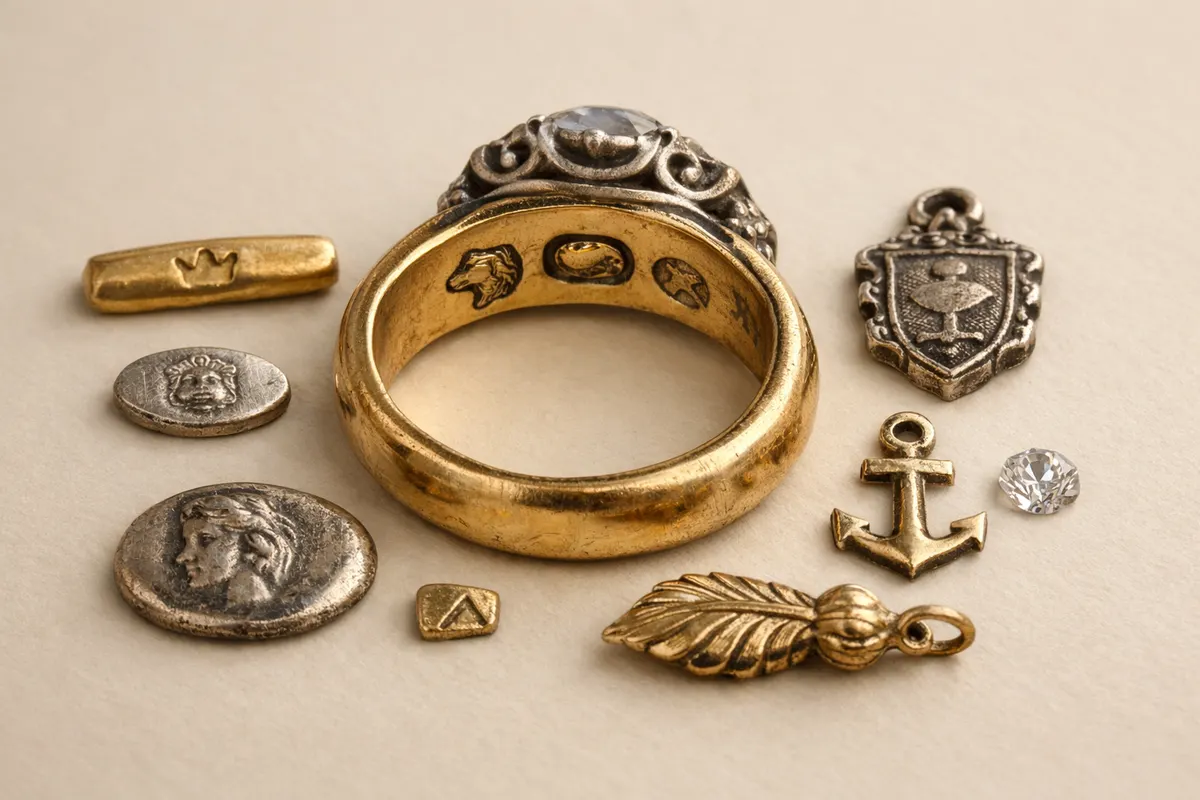
What jewelry hallmarks and maker's marks are
Jewelry hallmarks are stamped symbols, numbers, or letters applied to a piece to record information about the metal, maker, assay office, or date. Maker's marks (also called sponsor or maker marks) identify the workshop or individual who produced the item, while standard hallmarks often indicate metal content or official assay verification in regulated markets.
Hallmarks vary by country and period: a British piece may carry an assay office mark and a date letter, while a continental or U.S. piece may use numeric fineness stamps such as “925” for sterling silver or “750” for 18k gold. Smaller workshops sometimes use only a maker's initials and no fineness mark.
For everyday identification, hallmarks are practical clues: they help sort pieces by likely metal, narrow down origin and era, and—combined with style and construction—contribute to an informed estimate of value. However, a photo can only show what is visible; laboratory tests or provenance are needed to confirm purity, authenticity, or exact age.
- Hallmark = official or commercial stamp about metal or assay.
- Maker's mark = workshop or craftsman signature (initials, symbol).
- Not all marked pieces were assayed; some bear only commercial stamps.
- A visible hallmark is a strong clue but not definitive proof of metal purity or authenticity.
How can you tell jewelry hallmarks from a photo?
A good photo can reveal several hallmark signals: clear stamped characters, punch shapes, placement near clasps or inside rings, and overall wear that affects a stamp's clarity. For ring stamps, shoot the inner band at a perpendicular angle with even light; for pendants and clasps, include the surrounding area so you can see how the mark relates to construction and soldering.
Look for consistent depth and crisp edges in the stamp. Factory-applied fineness stamps (numbers like 585, 750, 925) tend to be regular and machine-struck, while hand-punched maker's marks can be irregular. Shallow, blurred, or cut-off marks are often caused by polishing or filing rather than deliberate falsification.
Use scale and context in the photo: include a ruler or coin and a wider shot of the whole piece. Magnified loupe-style photos help read tiny letters, but beware reflections and overexposure that wash out stamps. Note surrounding characteristics—solder joins, hallmark placement, and patina—because inconsistent repairs or re-stamping are red flags.
Simple at-home checks you can mention in a caption or supplementary image: a magnet test (non-magnetic metals like gold and silver should not stick), weight relative to size, and visible plating wear where a gold layer peels to a different color core. These checks support, but do not replace, assay or XRF testing.
- Photograph stamps perpendicular to the surface with even diffuse light.
- Include a scale reference and a full-piece shot for context.
- Compare font, punch shape, and placement to known examples.
- Look for polish or re-stamping signs—irregular edges or layered metal.
Key facts about jewelry hallmarks
This compact reference lists the hallmark attributes most useful to identify from photos. Use the table below to match visible marks with typical meanings and photo clues that help you interpret them.
Remember that formats vary internationally and historically: some marks are country-specific assay marks, others are numeric fineness stamps, and maker's marks can be almost any small symbol or set of initials.
| Attribute | What to look for in photos | Typical examples |
|---|---|---|
| Composition indicator | Numeric fineness or metal name stamped clearly | 925 (sterling silver), 750 (18k gold), 585 (14k gold) |
| Maker's mark | Small initials or emblem, often near solder joints | JR in a shield, a tiny anchor, or workshop initials |
| Assay office/official hallmark | Distinct local symbol or city mark, often with date letter | Leopard's head (London), eagle head (France) |
| Date letter or year code | Single letter in a defined font or cartouche | Letter punch indicating assay year in UK system |
| Placement and depth | Where the mark sits and how sharply it is punched | Inside ring band, under clasp, shallow vs crisp punch |
What jewelry hallmarks typically indicate about value
Hallmarks themselves do not assign a price, but they influence resale expectations by indicating likely metal content, origin, and maker reputation. In the secondhand market value is driven by metal weight and fineness, maker desirability, condition, and demand for the style or period.
All price guidance here is cautious and secondhand-market based: use these tiers as a starting point for shortlisting, not as appraised values. Local market trends, remounting costs, and verification testing (XRF or assay) can materially change the outcome.
| Tier | Typical resale range (secondhand) | What drives it |
|---|---|---|
| Everyday metal piece | US$10–US$150 | Sterling silver or low-weight gold plated or thin 9k items; condition and weight |
| Mid-range marked gold or vintage silver | US$150–US$1,000 | Solid 14k–18k items with moderate weight, identifiable maker, or desirable vintage styling |
| High-end maker or heavy bullion metal | US$1,000–US$10,000+ | Heavy 18k/22k pieces, notable makers, or fashionable period pieces in good condition |
| Collectible or rare maker | Varies widely; often premium pricing | Documented provenance, famous makers, or rare national assay marks |
- A clear 925 stamp usually supports silver resale value tied to weight and condition.
- An 18k or 14k gold stamp corresponds to intrinsic metal value plus any collector premium.
- Well-documented maker's marks (recognized houses) can add a multiple beyond metal alone.
What hallmarks are commonly confused with
Some marks resemble official hallmarks but are only commercial stamps, while others are decorative punches or damage that mimic letters and numbers. Photos can usually separate these by context, depth, and consistency.
Counterfeit or ambiguous marks are a real risk: some dishonest sellers re-stamp or plate pieces to simulate higher-fineness metal. Look for mismatched wear, layered metal at the stamp site, or misaligned punch impressions as photographic red flags.
- Plating vs true fineness stamp — look for two-tone wear where a thin gold layer exposes a different base metal.
- Decorative maker mark vs assay mark — official hallmarks tend to follow local formats and appear in predictable spots; decorative marks may be randomly placed and stylistically different.
- Shallow polish marks vs genuine punch — superficial scratches or buffing marks can appear like letters when magnified.
- Re-stamping or repair marks — inconsistent depth, crooked orientation, or fresh metal around a stamp often indicate a later intervention.
Care and handling
Treat hallmarks with care: aggressive polishing can remove or blur tiny stamps, reducing the ability to identify maker or fineness. When photographing, avoid harsh flash and use diffuse light to preserve the stamp's readable contrast.
If you plan to sell, appraise, or test a marked piece, keep any attached documentation, original boxes, or receipts. Handle pieces with clean, dry hands or cotton gloves to avoid transferring oils that reduce stamp visibility over time.
- Avoid over-polishing on stamped areas; consult a jeweler before heavy restoration.
- Record clear photographs of any hallmark before sending a piece for cleaning or repair.
- For suspected high-value items, seek professional testing (XRF) rather than relying solely on stamps.
Frequently asked questions
What does a '925' hallmark mean on jewelry?
A '925' hallmark indicates sterling silver, meaning the metal is approximately 92.5% pure silver alloyed with other metals for strength. In photos, the '925' stamp should be clear and consistent with the piece’s placement and construction; if it’s shallow, misaligned, or surrounded by recent soldering, treat it with caution and consider further testing.
Can a photo alone prove a piece is solid gold?
No — a photo can show a fineness stamp like '750' or '14k' and reveal visual clues such as weight appearance or two-tone wear, but it cannot prove metal purity. Non-invasive tests like XRF or an assay are needed for confirmation; photos are a useful first pass but not definitive.
How do you read maker's marks when they're just initials?
Maker's marks that are initials often require comparison to reference lists for the relevant country and era. In photos, capture the full mark, surrounding shaping, and any attendant hallmarks; those contextual clues (font shape, cartouche, placement) help narrow down candidates before consulting maker directories or specialist databases.
What should I do if a hallmark is worn or unreadable?
If a hallmark is worn, take multiple high-resolution images under angled, diffuse lighting and include a magnified close-up. Note other clues such as construction, metal color, and style. If identification affects value or authenticity, arrange professional testing or an in-person appraisal rather than relying solely on visual evidence.
Related guides
Compare your photo to hallmark clues with Jewelry Identifier
Use the Jewelry Identifier app on iOS to compare a clear photo of your piece against the hallmark and maker-mark clues outlined here. Start with a perpendicular close-up of any stamp, a wider context shot showing clasps or band placement, and a scale reference (coin or ruler). The app can help shortlist likely fineness stamps and maker matches as a first pass, but always follow up with testing or a professional appraisal for valuation or authentication.
Take the next step →