

Jewelry Identification
Turquoise: Identification, Value, and Real Examples
Learn how to spot turquoise jewelry from photos, which visible clues matter, and realistic secondhand value ranges to expect before you pursue an appraisal.
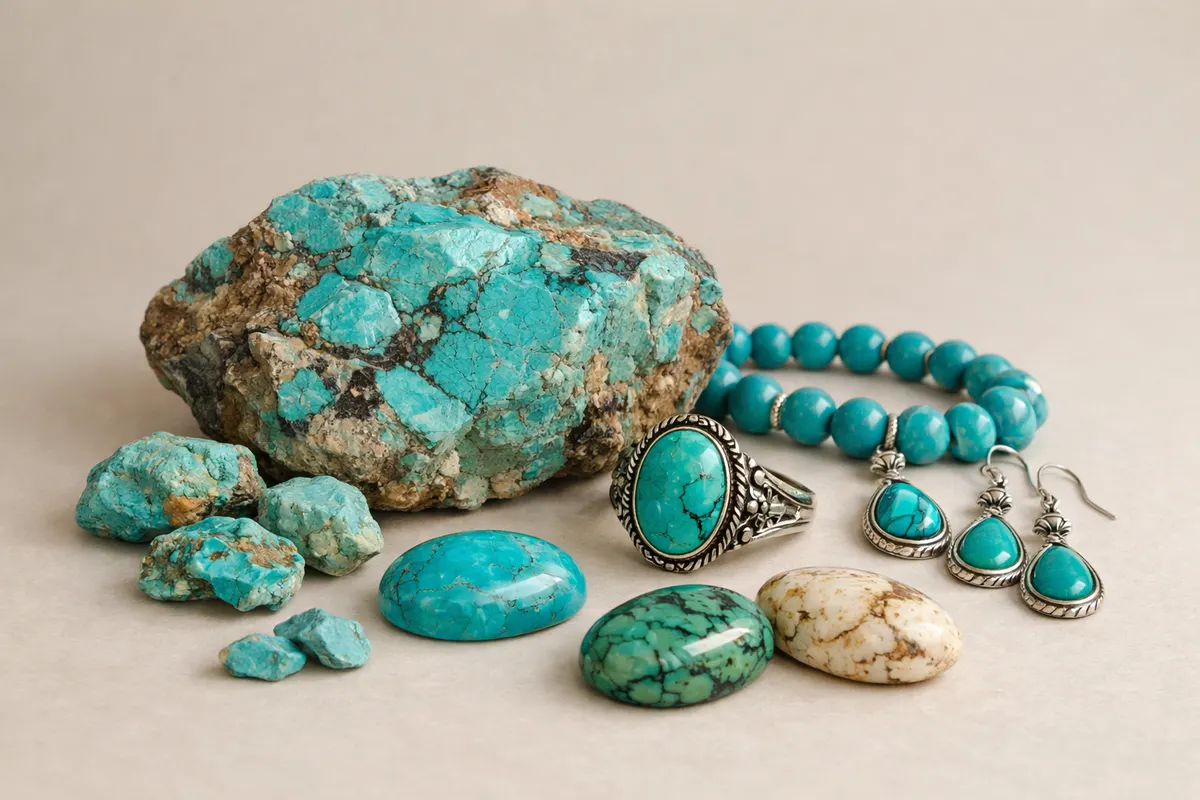
What turquoise is in jewelry
Turquoise is an opaque hydrated phosphate mineral valued for its blue-to-green tones and often-used as cabochons, beads, and inlay in silver and gold settings. In jewelry it appears most commonly as polished cabochons, flat inlays, and stringed beads — not faceted stones.
Chemically, turquoise is a copper- and aluminum-bearing phosphate (CuAl6(PO4)4(OH)8·4H2O). The copper content produces the familiar blue hues; iron impurities shift color toward green. Natural turquoise varies by source: Persian turquoise tends toward sky-blue, while some American deposits produce greener material with heavier matrix.
Because turquoise is relatively soft (see specs), many rough or lower-grade pieces are stabilized with resins or consolidated into reconstituted slabs before cutting. Those treatments change handling and value but are common in commercial jewelry.
Quick takeaway: when you see a smooth, matte-to-waxy blue or green stone used as a cabochon or bead, turquoise is a strong candidate — but visible clues and treatment signs determine how confident you can be from a photo alone.
- Typical forms in jewelry: cabochons, beads, flat inlays, carved accents.
- Color range: robin’s-egg blue through greenish-blue; matrix can be brown, black, or gray.
- Common sources: historically Persia (Iran), the American Southwest (Arizona, New Mexico), China.
- Treatments common: stabilization (resin impregnation) and reconstitution (crumb-plus-binder).
How can you tell if turquoise is real from photos?
Photos can show many useful clues for turquoise jewelry, but they cannot prove authenticity or value alone. Start with color and texture: natural turquoise usually shows small, uneven color zones and a slightly chalky to waxy surface when fresh; perfect, flat, neon-blue color with glassy shine is a red flag for dye or plastic.
Examine the matrix (veining): real turquoise often has irregular brown, black, or gray matrix that follows natural fractures. If the dark lines look painted on, perfectly regular, or show color pooling only on surface cracks, the piece may be dyed howlite or reconstituted material.
Use close-up magnification in photos (macro). At 5–10× magnification you can look for tiny pores and an uneven grain. Stabilized turquoise can look slightly glassy where resin filled pores; untreated turquoise tends to show a softer, chalkier texture. Dye concentration in pore edges or hairline fractures is a strong sign of dyed howlite or treated material.
Other photo-checks: check edges and drill holes on beads — dyed howlite often shows a white core with dye ringing. Look at the setting: high-quality turquoise is often set in bezel settings that protect edges; inexpensive glued-in stones or obvious resin overflow suggest treated or composite materials.
- Color uniformity: perfectly uniform bright blue → suspect dye or plastic.
- Matrix pattern: natural matrix is irregular; painted/printed veins look too regular.
- Edge and hole checks: white core at bead holes signals dyed howlite or magnesite.
- Surface shine: overly glassy finish may indicate heavy resin stabilization or plastic.
Turquoise key facts at a glance
The table below lists concise attributes collectors and buyers check first. These are practical, photo-relevant facts — refer to the identification section for visual clues you can confirm in pictures.
Note that hardness and treatments affect how the stone is used in jewelry and how it should be handled; stabilized or reconstituted materials behave differently from untreated turquoise.
| Attribute | Typical value | Notes |
|---|---|---|
| Composition | Hydrated copper-aluminum phosphate | Cu-bearing mineral — copper gives blue color |
| Mohs hardness | 5–6 (often 5–5.5) | Relatively soft for gems; scratches more easily than quartz |
| Appearance | Opaque, blue to green, often veined | Surface ranges from chalky to waxy; polish varies |
| Common treatments | Stabilized, dyed, reconstituted | Stabilization fills pores; reconstituted uses crushed stone + binder |
| Typical settings | Bezel-set cabochons, silver inlays, bead strings | Protected settings are common to prevent abrasion |
| Care sensitivity | Sensitive to acids, heat, and solvents | Avoid ultrasonic cleaners and household chemicals |
What turquoise jewelry is typically worth (used market)
Turquoise resale values vary widely depending on color, source, size, matrix, treatment, and the setting. The table below provides broad secondhand-market tiers and what typically moves a piece from one tier to the next. Treat these ranges as general guidance — they are not appraisals.
Key drivers: untreated, desirable-source stones with even, vivid color and minimal matrix command the highest prices. Stabilized or reconstituted material and tiny stones set in mass-market silver sell for much lower amounts even if attractive.
| Tier | Typical secondhand range (stone or small piece) | What drives price |
|---|---|---|
| Low-grade / costume | $5–$50 | Dyed howlite, low-quality stabilized or plastic imitations; mass-market settings |
| Common stabilized pieces | $50–$300 | Small to medium beads or cabochons stabilized for durability; standard silver settings |
| Good quality, attractive color | $300–$1,000 | Larger cabochons, even vivid color, moderate matrix, partial stabilization |
| Top-quality / desirable source | $1,000–$5,000+ | Untreated, vivid sky-blue stones from prized sources or museum-quality pieces; provenance increases value |
| Collector or designer pieces | Varies widely (often above stone value) | Historic pieces, named makers, or gold settings can push price far beyond stone alone |
- High-grade, untreated Persian or top Sleeping Beauty turquoise often reaches the highest resale per carat.
- Stabilized yet attractive stones hold modest value but are more durable in daily-wear jewelry.
- Designer provenance or fine metal settings (gold, named maker) increase resale beyond the stone alone.
Commonly confused with
Turquoise is most often confused in photos with dyed howlite and magnesite, reconstituted turquoise, chrysocolla, and glass or plastic imitations. Each lookalike has visual giveaways you can check under magnification.
Dyed howlite and magnesite start white and accept dye readily; in close-up photos you'll sometimes see color concentrated at grain boundaries or a white core in drilled beads. Their veining often appears too regular and in stark black rather than the brown, rusty matrix typical of natural turquoise.
Reconstituted turquoise (stone powder bound with resin) can show very uniform color and a slightly granular surface at high magnification; seams or glue lines near inlays are telltale. Chrysocolla can share blue-green tones but may be more translucent in places and show different fracture patterns.
- Dyed howlite: white core at drilled holes; dye pools in pores and along veins.
- Magnesite: similar to howlite; often dyed and has different veining under magnification.
- Reconstituted: very uniform color, granular texture; look for seams or binder shine.
- Glass/plastic: overly glassy, perfect color, or injection marks at edges.
Caring for turquoise jewelry
Turquoise is porous and chemically sensitive. Avoid prolonged contact with perfumes, cosmetics, sweat, and household chemicals; acids and solvents can change the stone’s color or damage stabilizing resins.
Clean gently with a soft, dry or slightly damp cloth. Do not use ultrasonic or steam cleaners. If the stone is set in silver, clean the metal carefully with a cloth that does not contact the turquoise, or use a targeted silver polishing method that keeps solutions away from the stone.
If a piece seems heavily stabilized or reconstituted, treat it as more durable but still avoid strong cleaners. For heirlooms or valuable pieces consider periodic check-ups with a jeweler experienced in turquoise who can advise on conservation or re-setting.
- Daily wear: avoid exposure to lotions, oils, and chlorine.
- Storage: keep in a padded box away from harder gems to prevent scratches.
- Cleaning: soft cloth only; no steam or ultrasonic cleaning.
Frequently asked questions
Can you tell if turquoise is real from a photo?
A photo can show strong clues — color uniformity, matrix pattern, surface texture, and drill-hole behavior — that suggest whether a piece is natural, dyed, or reconstituted. However, photos cannot provide definitive proof of authenticity or untreated status. For high-value pieces or when the treatment history matters, an in-person inspection or lab report (gemological testing) is necessary.
How can I tell dyed howlite from real turquoise in pictures?
Dyed howlite often exhibits perfectly regular black veining and an unnaturally uniform color. Close-up photos of bead holes may reveal a white core with dye ringed at the surface. Magnified views that show dye concentrated in surface pores or along fractures are a strong sign the piece is dyed rather than natural turquoise.
Does genuine turquoise change color over time?
Untreated turquoise can change subtly with exposure to oils, sunlight, and skin contact; it may darken or develop a slightly greener cast. Heavy stabilization or coatings reduce these changes but can give the stone a glossier appearance. Any significant or sudden color change warrants professional inspection to check for coatings or poor-quality treatments.
Is turquoise jewelry a good investment?
Some high-quality, untreated turquoise from desirable sources can hold or increase value, especially in collector markets. Most commercial turquoise jewelry — stabilized stones set in common silver mounts — is modestly priced on the secondhand market. Treat turquoise purchases as value-sensitive: provenance, untreated status, and desirable color substantially affect resale, so get specialist advice for anything you suspect is high-end.
Related guides
Compare your photo to these turquoise clues with Jewelry Identifier
Use the Jewelry Identifier iOS app as a careful first pass: take clear macro photos of the stone, drill holes, matrix, and setting to compare against the visual clues on this page. The app can help highlight likely matches and possible treatments, but it cannot replace in-person appraisal or laboratory testing. If a photo flags a potentially valuable or unusual piece, follow up with a qualified jeweler or gem lab. For broader visual-check guidance, see How to Tell if Jewelry Is Real: Safe Visual Checks Before You Trust a Match (https://jewelry-identifier.app/blog/how-to-tell-if-jewelry-is-real) and Jewelry Appraisal: Visual Clues, Examples, and Safe Next Steps (https://jewelry-identifier.app/identify/jewelry-appraisal).
Take the next step →