

Jewelry Identification
Victorian Jewelry: Identification, Value, and Real Examples
Victorian jewelry photo clues, hallmark signals, and cautious resale ranges — what a picture can show and what still needs hands-on checks before valuing.
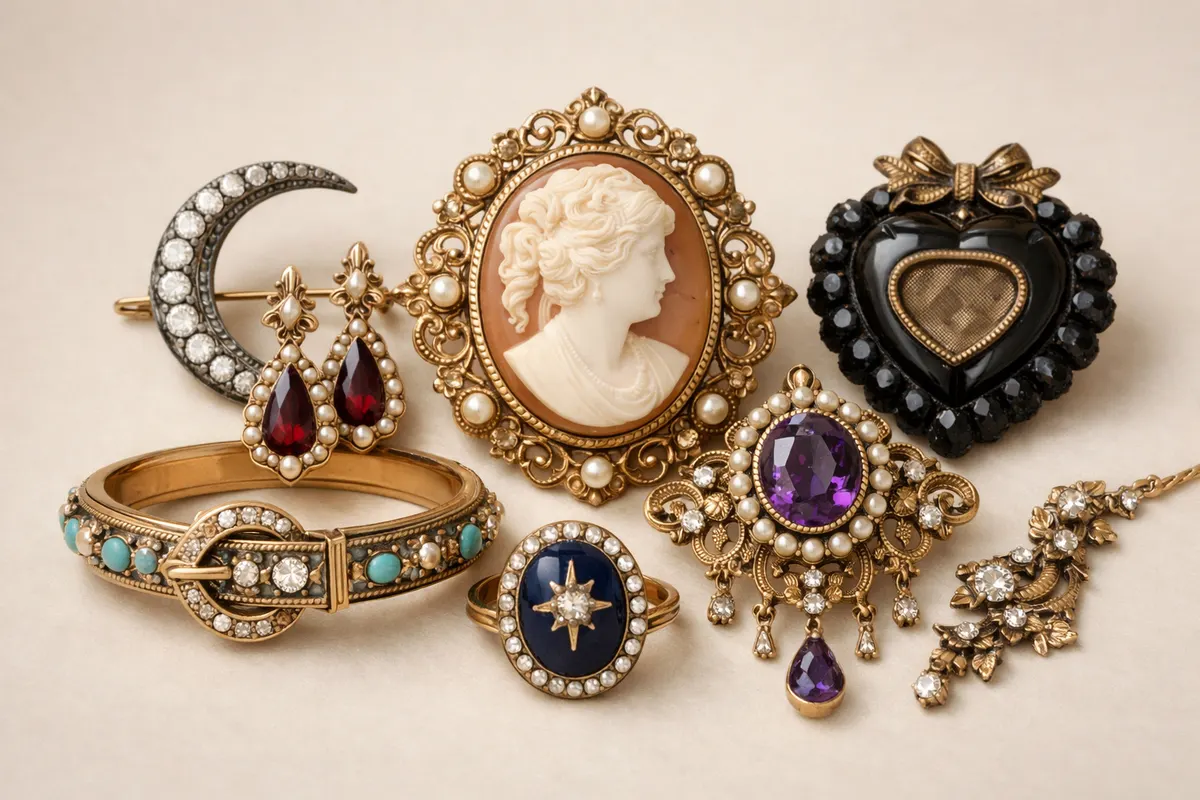
What Victorian jewelry is and where it came from
Victorian jewelry refers to pieces made during Queen Victoria’s reign (1837–1901). It covers several distinct sub-eras — early Romantic, mid-Victorian (also called Grand Period), and late or Aesthetic/Art Nouveau–influenced styles — and includes a wide range of materials, from high-karat gold and natural gemstones to gutta-percha, jet, and early plated metals used in costume pieces.
Designs reflect changing cultural tastes: sentimental motifs (hairwork, lockets, mourning pieces) dominate the early and mid periods, while late-Victorian work often favors lighter, more naturalistic forms and mixed metals. Makers ranged from small city workshops to large firms supplying middle-class markets, so construction quality varies widely.
Because the era spans more than six decades, 'Victorian' describes an age and look rather than a single manufacturing method. When identifying a piece, combine visible stylistic cues with construction and marks to reach a plausible attribution — then treat that attribution as a working hypothesis, not definitive proof of age or value.
- Timeframe: 1837–1901, with Early, Mid, and Late sub-eras.
- Typical motifs: lockets, hairwork, mourning black jet, serpent rings, seed pearls, floral enamels.
- Materials vary: high-karat gold and silver jewelry alongside early plating, gutta-percha, and mass-produced base-metal pieces.
- Attribution requires combining style, marks, and construction; no single visual cue proves authenticity.
How can you tell if a piece is Victorian from photos?
Photos can reveal strong clues about whether a piece is Victorian, but they have limits. Look first for composition and surface signs: hand-engraved or chased details, evidence of old solder joints, and natural-wear patterns on high points are consistent with older, handworked pieces. Machine-cut symmetry, stamped repeat patterns, or uniform plating are more likely later or reproduction work.
Hallmarks and maker marks are among the most useful photo-checkable signals. Clear date letters, town marks (in British pieces), or maker initials can narrow age and origin. However, many continental pieces and some small workshops were unmarked, and hallmarks can be added later; treat marks as strong leads, not final proof.
Gemstone and setting clues help as well: early seed pearls and rose-cut diamonds set in closed back settings, foiled stones, and collet or closed-bezel settings are typical of mid-19th-century techniques. Late-Victorian pieces sometimes use lighter settings and more open backs. Photographs that include clear close-ups of the setting backs and prongs are far more useful than single distant shots.
Wear and repair tell their own story. Old solder repairs that match the base metal and age-appropriate wear around hinge pins, clasps, and ear wires point toward genuine age. Conversely, perfectly sharp tooling marks, modern jump rings, or indistinct surface corrosion inconsistent with the claimed metal suggest later manufacture or poor reproduction.
- Photo checklist: clear close-up of hallmarks, high-resolution image of the setting back, macro shot of clasp/hinge, and a scale reference.
- Hallmarks: readable assay marks, date letters, or maker initials are strong clues when present.
- Settings: closed backs, collet bezels, foiled stones, and seed-pearl strings favor older origin.
- Construction: evidence of hand engraving, old solder seams, and aged hinge work supports a Victorian age; identical machine stamps usually do not.
Key facts
The table below summarizes the common attributes and the photo-checkable signals that help identify Victorian jewelry. Use these quick facts when you examine images: focus on marks, setting style, and construction details that survive photography well.
Remember that exceptions are common: some high-quality Victorian pieces were repaired or restyled later, and many reproductions intentionally mimic old techniques. Treat the table as an identification shortcut rather than definitive proof.
| Attribute | Typical Victorian example | Photo-checkable clue |
|---|---|---|
| Composition | High-karat yellow gold, silver, jet, gutta-percha, early plating | Warm yellow patina for gold, black jet with sheen, visible layered plating wear |
| Hardness & finish | Soft metals with hand-tool marks | Irregular tool marks, hand-chased lines, worn high points |
| Common marks | British assay marks, maker’s initials, few continental stamps | Legible hallmarks, punch marks near clasps/backs |
| Typical settings | Closed-back settings, collet bezels, foiled stones, seed pearls | Closed stone backs, foil showing under gems, small collet rims |
| Care sensitivity | Sensitive to heat, acids; some materials brittle (gutta-percha, jet) | Discolored or cracked organic materials visible at magnification |
- Capture photos in natural light and include a millimeter or coin for scale.
- When possible, photograph hallmarks at different angles to reduce glare from metal surfaces.
What Victorian jewelry typically sells for today
Secondhand market value for Victorian jewelry depends on material, rarity, condition, maker, and provenance. Prices vary widely: costume or heavily restored items often fall at the low end, while high-quality, original-condition pieces with desirable gemstones or known makers reach higher tiers. Use the ranges below as a cautious starting point for resale expectations, not as certified appraisals.
Condition and repair history heavily influence realized prices. A rare maker’s mark, original box, or documented provenance can multiply value. Conversely, modern solder, replaced stones, or harsh cleaning often reduce market interest and price.
| Tier | Typical resale range (USD) | What drives price within tier |
|---|---|---|
| Low | $30–$200 | Costume pieces, plated metals, heavy restoration, common designs |
| Mid | $200–$1,200 | Sterling or solid small gold items, modest gems, decent original condition |
| High | $1,200–$12,000 | High-karat gold, quality rose-cut diamonds, rare enamels, documented provenance |
| Collectors / Museum | $12,000+ | Exceptional provenance, major makers, museum-quality craftsmanship or rare gemstones |
- Ranges are secondhand-sales estimates and assume neutral market conditions.
- Regional demand and auction versus private sale channels cause meaningful price variation.
What Victorian jewelry is often mistaken for
Victorian pieces are commonly confused with adjacent-era work and later revivals. Photographs can catch many of the tell-tale differences, but look closely at construction and finishes to separate originals from lookalikes.
Reproductions made in the 20th and 21st centuries intentionally copy Victorian motifs; these often reveal modern tooling, machine-made uniformity, and modern solder colors when viewed up close.
- Art Nouveau / Late 19th-century: more flowing, organic lines and use of enamel — look for asymmetry and softer soldering versus rigid earlier Victorian geometry.
- Edwardian jewelry (early 1900s): lighter platinum settings and filigree work; photos that show platinum stamps or exquisitely fine milgrain point away from heavier Victorian construction.
- Costume or plated reproductions: identical repeat patterns, lack of hallmarks, and visible base metal where plating has worn off are common red flags.
- Revival pieces: modern metals and machine-cut stones, perfectly even prongs, and laser engraving indicate later manufacture.
Care and handling specific to Victorian pieces
Victorian jewelry often uses materials sensitive to modern cleaning: foiled gemstones, organic substances (jet, gutta-percha, hairwork), and antique lacquers can be damaged by ultrasonic cleaners, steam, or strong chemical dips. Clean gently with a soft brush and mild soap in lukewarm water, avoiding soaked organic parts.
When a piece includes fragile elements (seed pearls, hair insets, glued stones), store flat and padded to prevent stress on old threads or adhesives. For valuable or uncertain pieces, consult a professional conservator or jeweler before any restoration or relining.
- Avoid harsh polishes and ultrasonic cleaning on foiled or organic materials.
- Use a soft toothbrush and mild detergent for dirt removal; dry thoroughly to prevent moisture damage.
- Keep pieces separated to avoid abrasion; store in a padded, acid-free box or cloth.
Frequently asked questions
Can I identify Victorian jewelry from a single photo?
A single photo can provide useful clues — such as style, visible hallmarks, and basic construction — but it rarely proves age or authenticity on its own. Multiple high-resolution images (close-ups of hallmarks, backs of settings, clasps, and any repair areas) plus scale references increase confidence. Always treat photo-based identifications as provisional and follow up with hands-on inspection or a professional appraisal for value or legal provenance needs.
What hallmarks or marks should I look for on Victorian pieces?
Look for readable assay marks (country and town marks), date letters (especially on British pieces), maker’s initials punched near clasps or inside boxes, and style-specific stamps. Many continental and small-workshop pieces lack formal assay marks. If you find marks, photograph them clearly and compare them to hallmark references; marks help narrow date and origin but can be forged or added, so combine marks with construction and wear clues.
Which features most increase resale value for Victorian jewelry?
Higher value is driven by original condition, precious metals (solid high-karat gold, platinum), rare or high-quality gemstones (rose-cut diamonds, natural pearls), exceptional enamel work, documented provenance, and maker attribution. Condition and intact original settings matter more than motif alone. Conversely, heavy repairs, modern replacements, or poor cleaning typically reduce resale value substantially.
How can I be more certain a piece is genuine Victorian before selling?
Combine multiple lines of evidence: clear photographs of hallmarks and construction, documentation or provenance if available, and an evaluation of materials and repair history. Use magnified images to check solder seam color and tool marks. For higher-value items, consult a reputable appraiser or jewelry conservator for an in-person inspection and written opinion; photographic review is a helpful first step but not a substitute for hands-on verification.
Related guides
Compare your photo to Victorian ID clues with Jewelry Identifier
After you check hallmarks, settings, and wear in your images, use Jewelry Identifier as a first pass to compare a photo of your piece against the Victorian clues on this page. The app (https://jewelry-identifier.app/tools/jewelry-identifier) can help highlight matching features and possible lookalikes, but treat its results as a visual aid. For anything that may be valuable, follow up with an in-person appraisal or conservator review before making decisions.
Take the next step →